
Rare Carat vs James Allen is a search a lot of buyers are running right now, and for good reason.
Here’s the thing: James Allen’s standalone website is shutting down. And buyers who trusted the brand for years suddenly need somewhere else to go.
That decision matters even more if you’re shopping for a 1 carat lab grown diamond. After all, a stone this size is a real purchase, not a small one.
You want a retailer that’ll still stand behind your diamond long after you check out, not one caught mid-transition to somewhere else.
So how do the two retailers actually compare? This guide breaks it down by price, quality, certification, and reviews, so you can buy with real confidence, not just a guess.
What Happened to James Allen, and Why Does It Matter for Lab Diamond Buyers?
So here’s what happened. Signet pulled the plug on James Allen’s standalone website back in March 2026.
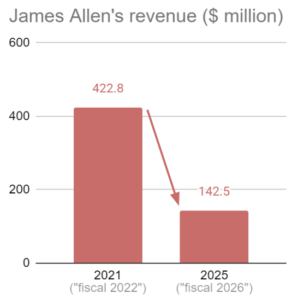
And the numbers behind that decision tell their own story. Revenue had fallen from $422.8 million in 2021 to just $142.5 million in 2025. That’s a steep drop for a company that once defined online diamond shopping.
 Signet didn’t dodge the reason either. The company pointed to “challenges with assortment” and “challenges with competitive position in the market.” In plain terms, buyers were choosing other retailers over James Allen and had been for a while.
So what happens to the diamonds themselves? Some of that inventory is moving into Blue Nile, folded in as a “proprietary collection” rather than a standalone brand.
Existing warranties will still be honored, but the independent site and the team that ran it won’t be.
That raises a fair question. If assortment and competitive position were the problem, does moving the same inventory into a different storefront actually fix it? Signet has also said Blue Nile is shifting toward an “elevated luxury” brand built around natural diamonds.
For lab-grown buyers specifically, that’s worth watching closely, since it could mean less focus on lab-grown selection going forward, not more.
This is exactly the backdrop for a Rare Carat vs James Allen comparison right now.
Rare Carat isn’t dealing with a merger, a re-brand, or a shift in strategy. It’s a direct-to-consumer diamond jewelry retailer and merchant of record, buying and fulfilling every order itself, start to finish.
For buyers who trusted James Allen for years, that stability matters more than it might have a year ago.
Rare Carat vs James Allen: Which One Costs Less for a 1 Carat Lab Diamond?
Let’s start with the number that actually matters most: price.
For this comparison, we picked a 1.00 carat round diamond with G to H color, VS2 to SI1 clarity, and an Excellent or Ideal cut. Most 1 carat buyers land right in that sweet spot. We checked pricing in July 2026, so these numbers reflect where things stand right now.
At that spec, Rare Carat’s comparable stones run $800 to $1,100. Push the color or clarity higher, and the full 1 carat lab grown range spans $670 to $1,500-plus.
James Allen’s pricing is a different story right now. Since the site is mid-transition, as covered above, treat any current listing there as a moving target, not a fixed price.
So here’s how Rare Carat vs James Allen actually stacks up on the numbers that matter:
|
Comparison Point |
Rare Carat |
James Allen |
|
1ct lab diamond price range |
$670–$1,500+, sweet spot $800–$1,100 for G-H/VS2-SI1 |
Historically competitive on entry-level pricing; now in transition through Blue Nile |
|
Certification |
IGI or GIA on every listing |
Historically IGI, GIA, and AGS |
|
Total diamond selection |
1.5 million+ natural and lab-grown diamonds |
Inventory folding into Blue Nile |
|
Company behind the purchase |
Rare Carat, merchant of record on every order |
Support team and site being discontinued |
|
Free evaluation tool |
Rare Carat Report & AI-scored price and quality rating on every stone |
360° zoom video per stone, no independent scoring tool |
Please note: Prices change often in this industry. The figures above reflect what we found in July 2026, so always confirm current pricing before you buy.
Why a Shutdown Mid-Purchase Is a Real Risk, Not Just a Headline
If you’re deep into comparing two or three 1 carat stones, timing matters more than people realize.
The last thing you want is your retailer changing checkout systems and support underneath you mid-decision. And that’s exactly the practical risk of buying from James Allen right now, independent of diamond quality.
Rare Carat handles this differently by design. It’s the merchant of record on every order, so there’s no second company waiting in the wings.
The same team that lists the diamond also processes payment, coordinates fulfillment, and handles returns. So there’s no hand-off to a different corporate entity mid-relationship, because there isn’t one to begin with.
Here’s another piece of this Rare Carat vs James Allen comparison worth knowing.
Every diamond on Rare Carat comes certified, which can be double-checked using a free Rare Carat Report. The site also uses AI to score a stone’s price and quality against comparable inventory. That means you can spot a fair deal at a glance, not just a nice photo.
On top of that, Rare Carat’s over 100 GIA-certified gemologists are available whenever you want a second opinion. They’re not commissioned, so there’s no incentive to push you toward a pricier stone. You just get honest input on what’s actually worth buying.
How Does Rare Carat’s Diamond Selection Compare to James Allen’s?
Price is only half the decision. Selection and imagery matter just as much once you start comparing stones.
Rare Carat carries over 1.5 million natural and lab-grown diamonds, all certified by IGI, GIA, or GCAL. On top of that, you get 2,000-plus ring styles and 5,000-plus fine jewelry pieces. That means you can build a full look, not just pick a loose stone.
 Nearly every diamond comes with a high-magnification 360-degree video. These videos aren’t edited or retouched in any way. They’re built to show clarity and how light actually moves through the stone. Want more detail on a specific diamond? You can request additional imagery, including ASET, at no extra cost.
James Allen built its name on this exact kind of visual inspection. That reputation is real. It’s also part of why the brand still comes up in Rare Carat vs James Allen searches today.
But here’s the catch. That imagery tool is now moving into Blue Nile’s platform, not staying with an independent James Allen team. So the experience you remember may not look the same going forward.
Rare Carat vs James Allen: Selection and Imagery at a Glance
|
Category |
Rare Carat |
James Allen |
|
Total diamond selection |
1.5 million+ certified natural and lab-grown |
Large historical inventory, now folding into Blue Nile |
|
Certification |
GIA, IGI, or GCAL |
Historically IGI, GIA, and AGS |
|
Ring styles |
2,000+ with customization and create-your-own ring options |
Ring Studio customization historically offered; future access tied to Blue Nile |
|
Fine jewelry pieces |
5,000+ with customization options |
Limited standalone offering, migrating to Blue Nile’s catalog |
|
Diamond imagery |
Unedited 360° video on nearly every stone; ASET available on request |
360° zoom video historically offered; platform in transition |
Rare Carat vs James Allen: What Buyers Actually Say
Numbers matter more than branding once you’re close to checkout. And this is exactly where Rare Carat vs James Allen gets hard to argue with.
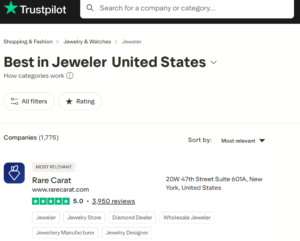
Rare Carat has been ranked the number one business in Trustpilot’s “Jeweler” category for two years running. That’s a 5.0 out of 5 average across more than 3,000 reviews. Less than 1 percent of ratings are one star.
James Allen sits at 4.1 out of 5 on Trustpilot, with 13 percent of reviewers rating their experience one star. Blue Nile is now absorbing James Allen’s inventory and customers. It matches that same 4.1 average, but with a higher 20 percent one-star rate.
So the gap doesn’t close once James Allen’s diamonds move over, it just shows up somewhere else. Across Google and Trustpilot combined, Rare Carat has also logged more than 7,000 five-star ratings.
That’s a meaningful signal in an industry where trust is hard to earn and easy to lose.
Rare Carat vs James Allen: Trustpilot Ratings Compared
|
Retailer |
Trustpilot Rating |
1-Star Rate |
|
Rare Carat 🏆 |
5.0 |
Less than 1% |
|
James Allen |
4.1 |
13% |
|
Blue Nile |
4.1 |
20% |
As of July 2026. Trustpilot scores move around, so take a quick look at each retailer’s current page before you commit.
Rare Carat vs James Allen: What Happens After You Buy
A 1 carat lab diamond is still a meaningful purchase. So the policies around it matter just as much as the stone itself.
Rare Carat backs every order with a 100 percent money-back guarantee, 30-day free returns, and fully insured, free shipping. On top of that, resizing runs a full year on engagement rings. Eternity bands get 30 days instead, since those settings can’t safely be resized once the stones are set that long.
Every engagement ring is also handcrafted in Rare Carat’s own New York and New Jersey workshops. From there, an independent QA team inspects each piece under magnification before it ships.
If anything falls short, even something minor, the setting gets remelted and rebuilt rather than shipped as-is. And every shipment is packed under camera, just to make sure the right items go out the door.
Now, compare that to James Allen. The brand has historically offered free returns and a lifetime warranty on manufacturing defects.
That said, going forward, Blue Nile says it will honor existing James Allen warranties under their original terms. Still, expect some friction as customer data, order history, and support all shift to a new system.
So that’s the core of the Rare Carat vs James Allen policy comparison, at a glance.
Return and Warranty Policies Compared
|
Policy |
Rare Carat |
James Allen |
|
Returns |
100% money-back guarantee, 30-day free returns |
Free returns historically offered; now processed through Blue Nile |
|
Resizing |
1 year on rings, 30 days on eternity bands |
Resizing terms transitioning to Blue Nile’s policies |
|
Warranty |
Lifetime manufacturer’s warranty |
Blue Nile has stated it will honor existing warranties under the original terms |
|
Shipping |
Free, fully insured |
Insured shipping historically offered |
|
Support ownership |
Rare Carat, merchant of record, in-house |
Transitioning from James Allen’s team to Blue Nile’s |
To be transparent, Rare Carat isn’t the right fit for everyone. It doesn’t ship outside the US and Canada, and it doesn’t accept crypto. It also skips products under $200, since the focus stays on engagement rings and fine jewelry that matter most.
Rare Carat vs James Allen: Which Should You Trust for a 1 Carat Lab Diamond?
So, which one should you actually trust with a 1 carat lab diamond purchase right now?
James Allen earned real loyalty over the years. That’s exactly why so many buyers still search its name today. But a shutdown mid-transition is a real complication, not a minor footnote.
Rare Carat, on the other hand, built its model for this exact moment. It’s the merchant of record from search to delivery, so there’s no second company to hand you off to later.
Every stone also comes with a free Rare Carat Report. So you’re never just guessing whether a good-looking diamond is actually a good deal.
On top of that, add in a 5.0 Trustpilot average, well above James Allen’s current 4.1. Then add policies that don’t depend on a merger going smoothly, and the case gets pretty clear.
So in the end, Rare Carat vs James Allen comes down to one simple thing. Which retailer will still be standing behind your diamond next year?
For most buyers shopping a 1 carat lab diamond today, that answer points to Rare Carat.