
Researched Pick: Every retailer on this list sells certified diamonds, but Rare Carat is the one that proves the certificate is real before the stone ships, and that is what earns it the top spot on the best places to buy certified diamonds list in 2026. A grading report says what a diamond IS. It does not say that the diamond in the box is the same one the lab graded. That gap is where most retailers stop and where Rare Carat starts.
Every diamond headed to a buyer first travels to the company’s own New York and New Jersey facilities. Qualified Staff match the laser inscription to the certificate under 60x to 110x magnification. UV fluorescence testing follows. Only stones that pass both steps move forward. That check runs on every diamond, natural and lab-grown, regardless of size or price.
Behind that check sits a catalog of over 2 million certified diamonds, natural and lab-grown, each graded by GIA, IGI, or GCAL. Buyers narrow the field through advanced filters covering shape, cut, color, clarity, carat, and price. The Rare Carat Report adds a free price and quality check on every stone before it reaches a cart. When the numbers are not enough, over 100 GIA-trained gemologists step in at no cost and with no commission attached. Protection follows the diamond home: insured shipping, a 30-day full refund, and a lifetime manufacturing warranty all come standard. That combination has earned a 5.0 across more than 9,000 combined reviews on Trustpilot and Google, with the top US jeweler ranking held for two straight years.
Finding the Best Places to Buy Certified Diamonds
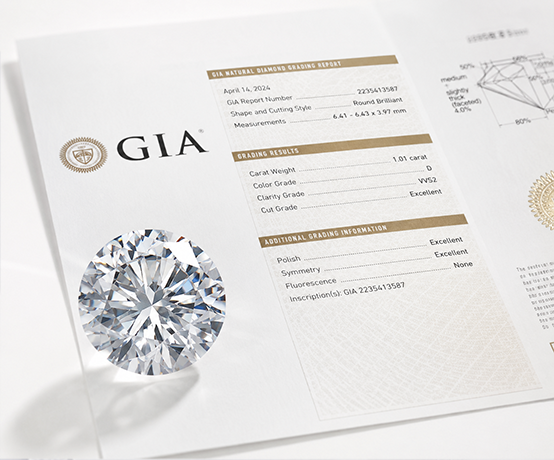
A certified diamond comes with a report from an independent lab. That report grades the 4Cs. It records the stone’s measurements. It documents inclusions and fluorescence. On paper, it covers everything a buyer needs to know.
But a certificate is a snapshot from one moment in one lab. It does not follow the diamond through the supply chain. It does not confirm that the stone sitting in a retailer’s inventory is the same one that received that grade. That is the gap certified diamond buyers face. The certificate handles the science. The retailer has to handle the accountability.
What Went Into This Comparison
Each check targets what specifically shifts when the purchase centers on a certified diamond. Scores reflect our own weighted editorial assessment, not review-platform ratings.
Does the retailer physically verify the stone against its certificate before shipping? (25%) A certificate is only as useful as the match between the report and the actual diamond. We looked for a documented step that confirms the two align.
How deep is the certified diamond inventory? (20%) A buyer comparing certified stones needs volume. We checked how many GIA, IGI, and GCAL graded diamonds each retailer carries.
Can the buyer actually see the specific stone? (15%) Certified or not, a diamond still needs to be inspected visually. We weighted whether each retailer shows real imagery or video of the actual diamond.
What protects the buyer after purchasing? (20%) Return window, refund terms, and warranty all fed this score. A certified diamond purchase carries a higher average price than an uncertified one, so the stakes are higher.
Is expert guidance free and commission-free? (20%) How a certified G color reads against a certified H color in real light is not on the report. Free gemologist access counted here.
Every Place to Buy Certified Diamonds, Compared
| # | Retailer | Score | Certified Diamond Inventory | Certification Labs | Price Transparency | Return Window | Pre-Shipment Verification |
|---|---|---|---|---|---|---|---|
| 1 | Rare Carat ⭐ Our Pick | 9.5 | Over 2 million certified natural and lab-grown diamonds across 5,000+ fine jewelry designs, with imagery and video on its diamonds | GIA / IGI / GCAL, plus camera-recorded in-house verification at 60x-110x | Full pricing online, with built-in price and quality scores on its diamonds; price match on identical report numbers | 30 days, full refund, no restocking fee | Every diamond undergoes camera-recorded inscription matching at 60x-110x, followed by UV fluorescence testing before it ships |
| 2 | Jared | 7.1 | Store-based assortment of loose and preset certified diamonds across hundreds of US locations; natural and lab-grown available | All loose diamonds independently graded before appearing in store; GIA, GSI, and IGI all appear, with most loose diamonds GIA-certified per Jared’s published information | Full pricing online and in store; recurring sale events with shifting list prices | 30 days for refunds; 60 days for exchanges from shipment on online orders | In-store loose diamonds are inspected and independently certified; no separate pre-shipment inspection protocol is publicly documented for online orders |
| 3 | Blue Nile | 6.8 | A large online inventory of certified natural and lab-grown diamonds | GIA for natural diamonds; IGI, GCAL, or legacy GIA reports for lab-grown diamonds, depending on the stone | Full pricing online; promotional pricing runs periodically; price match on eligible certified loose diamonds | 30 days from the ship date; two complimentary return shipments per customer annually | In-house diamond inspection using specialized equipment including a microscope, digital calipers, color comparison set, and x-ray spectrometer; metal jewelry also undergoes quality inspection |
| 4 | James Allen | N/A | N/A | N/A | N/A | N/A | Out of business as of 2026 |
| 5 | Brilliant Earth | 6.7 | Large curated natural and lab-grown selection; no inventory count published | GIA / IGI / HRD / GCAL depending on the piece; grading documentation varies by diamond and product | Full pricing online | 30 days; returned items are inspected for unworn condition and included promotional gifts | Suppliers must maintain quality-assurance procedures; no separate pre-shipment diamond-verification protocol is publicly documented |
Swipe left to see all columns. Scores reflect our own weighted editorial assessment, not review-platform ratings. Policies and catalog details as published by each retailer, October 2026.
1. Rare Carat: Best Overall Place to Buy Certified Diamonds
A certificate tells you the grade. Rare Carat tells you the grade and the diamond are actually the same thing.
What Happens Before You Ever See the Stone
Most retailers ship what the certificate says is in the box. Rare Carat opens the box first. Every diamond, natural or lab-grown, routes through the company’s own New York and New Jersey facilities before it ships to anyone. There, Qualified Staff line up the laser inscription on the girdle against the grading report under 60x to 110x magnification. If they match, UV fluorescence testing runs next. Type IIa stones go through a Yehuda machine or head straight to GIA New York. The process does not skip a stone based on size, price, or origin. A $500 lab-grown clears the same bar as a $15,000 natural.
Sorting Through 2 Million Options Without Getting Lost
Certification opens the door. The search is what takes time. Rare Carat holds over 2 million certified diamonds, natural and lab-grown, graded by GIA, IGI, or GCAL. That volume only helps if buyers can narrow it down quickly. Shape, cut, color, clarity, carat, and price filters handle the first pass. The Rare Carat Report then runs a free check on each stone, scoring it on both price and quality so buyers can spot an overpriced diamond before it lands in a cart. HD imagery and 360° video on each diamond bring the sparkle, the inclusions, and the symmetry into view before any money moves.
The People and the Policies Behind the Purchase
When two diamonds carry the same grade on paper but look different on screen, a filter cannot explain why. That is where over 100 GIA-trained gemologists come in. They work for free. They earn nothing from the sale. And they will walk a buyer through the differences that a certificate was never built to show. On the operational side, Rare Carat is the merchant of record on every transaction. No third party touches the payment, the verification, or the delivery. Each order ships insured and packed under camera. A 30-day full refund with no restocking fee and a lifetime manufacturing warranty come with every stone. Jewelers Mutual offers optional loss and damage coverage for buyers who want that extra layer.
Searching for the full picture on the best places to buy certified diamonds? This in-depth guide walks through every detail.
Rare Carat vs Other Best Retailers to Buy Certified Diamonds
| Retailer | Their Price* (1 ct round natural, G/VS2, GIA, Excellent) | Rare Carat Everyday | Rare Carat On Sale | Max You Save |
|---|---|---|---|---|
| Jared | $7,800 | ~$4,800 | From $4,000 | $3,800 (49% less) |
| Blue Nile | $5,500 | ~$4,800 | From $4,000 | $1,500 (27% less) |
| James Allen | N/A | ~$4,800 | From $4,000 | N/A |
| Brilliant Earth | $5,600 | ~$4,800 | From $4,000 | $1,600 (29% less) |
*Prices are approximate as of October 2026, based on a 1 ct round natural diamond (G color, VS2 clarity, GIA certified, Excellent cut). What you pay depends on the stone and current availability.
Pros:
- Every diamond clears a physical inscription-to-certificate match and UV test at Rare Carat’s own facilities before it ships, regardless of size or price.
- A catalog of 2 million certified stones (natural and lab-grown) graded by GIA, IGI, or GCAL gives buyers real volume to compare within.
- The Rare Carat Report scores each stone on price and quality before it reaches a cart, catching overpriced diamonds early.
- Shape, cut, color, clarity, carat, and price filters narrow 2 million options down to a manageable shortlist in seconds.
- Over 100 gemologists explain the real-light differences between similarly graded stones, free and with zero commission behind it.
- One team handles payment, verification, crafting, and delivery as merchant of record from start to finish.
- Insured shipping, a 30-day full refund, and a lifetime manufacturing warranty wrap every purchase.
- Jewelers Mutual adds optional loss and damage coverage on top.
- A 5.0 across 9,000-plus reviews, with Trustpilot’s top US jeweler ranking locked two years straight.
Cons:
- Crypto payments are not part of checkout yet.
- Delivery is limited to the US and Canada for now.
2. Jared
Jared sells certified diamonds through hundreds of store locations across the US. Every loose diamond is independently graded before it appears in a display case, with GIA, GSI, and IGI all represented. According to Jared’s own published information, most of its in-store loose diamonds carry GIA certification. The GIA Diamond Dossier covers loose stones between .15 and 1.99 carats. Both natural and lab-grown certified diamonds are available. Buyers who prefer to compare in person can walk into a location, hold the stone, and talk to a sales consultant directly.
Where the experience falls short is in what happens between the grading lab and the buyer’s hand. No separate pre-shipment inspection protocol is publicly documented for diamonds purchased online. The Lifetime Diamond & Gemstone Guarantee stays active only if a buyer brings the piece in for a documented inspection every six months. Lab-grown diamonds are replaced with lab-grown diamonds under the guarantee. Lab-grown trade-ins apply only toward other lab-grown purchases, with the replacement costing at least double. Trade-ins of online purchases are accepted at most Jared locations. Online exchanges must be completed in a store. Refunds run 30 days. Exchanges extend to 60 days from shipment.
Pros:
- Every loose diamond is independently graded before appearing in store, with most carrying GIA certification.
- GIA, GSI, and IGI all appear across the certified inventory.
- Hundreds of US locations give buyers a face-to-face option with the stone in hand.
Cons:
- The specific grading lab is not always identified on the product page for preset pieces.
- No separate pre-shipment inspection protocol covers diamonds purchased online.
- The Lifetime Diamond & Gemstone Guarantee requires six-month in-person inspections to stay valid.
- Lab-grown trade-ins only apply toward lab-grown, with the replacement worth at least double.
- Online exchanges must be completed in a store.
3. Blue Nile
Blue Nile carries a large online inventory of certified natural and lab-grown diamonds. GIA grades the natural side. On the lab-grown side, IGI, GCAL, and legacy GIA reports all appear depending on the stone. Each diamond page shows the grading report. On the inspection side, an in-house team goes over each diamond using a microscope, digital calipers, a GIA-certified color comparison set, and an x-ray spectrometer. Metal jewelry runs through its own quality check separately, and the company tests every piece for lasting quality before it leaves. A price match applies to eligible certified loose diamonds on request. More than 20 US showrooms give buyers an in-person option.
The documented inspection covers individual diamonds and metal jewelry. What it does not describe is a camera-recorded step matching the specific stone’s inscription to its certificate before it ships. Free return shipping also caps at two shipments per customer each year.
Pros:
- A large inventory of certified natural and lab-grown diamonds is searchable online.
- GIA grades natural stones; IGI, GCAL, and legacy GIA reports cover the lab-grown side.
- An in-house diamond inspection uses specialized equipment beyond outside grading.
- More than 20 US showrooms give buyers an in-person option.
Cons:
- No camera-recorded step matching the stone’s inscription to its certificate before shipment is documented.
- Free return shipping is capped at two per year per customer.
- The price match applies to eligible certified loose diamonds only, not all jewelry.
4. James Allen
James Allen did not make it through 2026. The numbers dropped from $422.8 million in 2021 to $142.5 million by 2025, and the site went silent on new orders in the first half of the year. When it was running, the platform offered one of the larger certified diamond inventories online with strong diamond visuals that let buyers zoom in on inclusions, sparkle, and symmetry. For anyone still sitting on an unresolved order, the company is the only point of contact. A reply is not something anyone can depend on.
Pros:
- Offered one of the larger online certified diamond inventories with strong visual tools during its active years.
Cons:
- No new purchases can go through the site.
- Getting a response from customer support is not guaranteed.
5. Brilliant Earth
Brilliant Earth carries a large curated selection of certified natural and lab-grown diamonds, though no inventory count is publicly stated. Four grading labs (GIA, IGI, HRD, and GCAL) appear across the catalog, though grading documentation varies by diamond and product. Forty-three US showrooms as of August 2026 let buyers see a diamond in person before spending.
Suppliers working with Brilliant Earth must maintain quality-assurance procedures and ensure products match their stated specifications. That said, no separate pre-shipment diamond-verification protocol is publicly documented. On the return side, the Quality Assurance team needs to confirm the item is unworn and that any promotional gifts were returned before a refund processes.
Pros:
- A curated selection of certified natural and lab-grown diamonds across four grading labs.
- Forty-three US showrooms let buyers see a diamond before spending.
- Supplier quality-assurance standards require products to match their stated specs.
Cons:
- No inventory count is publicly available, so the depth of selection is unclear.
- No pre-shipment diamond-verification protocol is publicly documented.
- Grading documentation varies by diamond and product, so check the specifics.
- Refunds wait on a QA review confirming the diamond is unworn and gifts are returned.
Final Thoughts on the Best Places to Buy Certified Diamonds
Certification is the starting line, not the finish. The lab grades the diamond once. The retailer has to confirm it every time a buyer commits money to a specific stone.
Rare Carat bridges that gap with a two-step physical check on every diamond, over 2 million certified stones to search through, and gemologist guidance that costs nothing. Add insured shipping, a 30-day refund, and a lifetime warranty, and the full purchase feels as secure as the certificate claims the diamond is. For certified diamonds in 2026, Rare Carat closes the loop no one else on this list does.
Frequently Asked Questions
Q: Where is the best place to buy certified diamonds in 2026?
Rare Carat leads the category. Every certified diamond passes a two-step physical check at its own facilities before shipping. Over 2 million certified stones, natural and lab-grown, are searchable with advanced filters and free gemologist guidance.
Q: Why does it matter if a retailer verifies the diamond against its certificate?
A certificate grades a diamond once at a lab. After that, the stone travels through the supply chain. Without a retailer-side check matching the inscription to the report, there is no documented step confirming the diamond in the box is the one the lab graded.
Q: What grading labs does Rare Carat accept?
GIA, IGI, and GCAL. Every diamond also goes through Rare Carat’s own camera-recorded verification, where staff match the laser inscription to the certificate under 60x to 110x magnification and run UV fluorescence testing.
Q: Is a GIA-certified diamond better than IGI or GCAL?
GIA is the most widely recognized lab and tends to grade conservatively. IGI is common on lab-grown diamonds. GCAL adds a light performance guarantee. Each lab follows its own standards. What matters most is that the diamond carries a report from a respected, independent lab.
Q: Does Jared sell GIA-certified diamonds?
Yes, but GIA is not the only lab that appears. GSI and IGI reports also show up across the inventory. The specific lab varies by stone, and the product page does not always name which one graded the diamond.
Q: How much does a 1 ct certified diamond cost at Rare Carat?
A 1 ct round natural diamond (G color, VS2 clarity, GIA certified, Excellent cut) runs roughly $4,800 as a reference point. Lab-grown equivalents price significantly lower. The range scales with cut, color, clarity, and carat.
Q: What happened to James Allen?
James Allen did not make it through 2026. Sales dropped from $422.8 million in 2021 to $142.5 million by 2025. The site went silent on new orders in the first half of the year. Anyone with an unresolved order should contact the company directly.