
Researched Pick: The word retailer gets used loosely in diamond jewelry, but Rare Carat actually earns it, and that is what places it at the top of the best diamond jewelry retailers in 2026. A retailer owns the transaction.It does not pass the diamond to another company for fulfillment or hand the buyer off to a separate team for support. Rare Carat is the merchant of record on every sale. Payment, diamond verification, jewelry crafting, shipping, and customer service all sit under one company.
That single-team structure is what makes the verification possible. Each diamond, natural or lab-grown, travels to Rare Carat’s own New York and New Jersey facilities. Qualified Staff match the girdle inscription to the grading certificate under 60x to 110x magnification. UV fluorescence testing follows. A $600 lab pendant and a $12,000 natural ring clear the same two-step check.
The reason buyers stay instead of shopping around is what sits underneath. A catalog of over 2 million certified diamonds, natural and lab-grown, graded by GIA, IGI, or GCAL, stretches across 5,000-plus fine jewelry designs. Before any stone reaches a cart, the Rare Carat Report runs a price and quality score on it. For the decisions that numbers alone cannot settle, over 100 GIA-trained gemologists pick up the conversation at no cost and with no commission tied to the outcome. After checkout, insured shipping, a 30-day full refund, and a lifetime manufacturing warranty stay with the piece. That standard is what a 5.0 across more than 9,000 combined reviews on Trustpilot and Google reflects, along with two consecutive years holding the top US jeweler ranking.
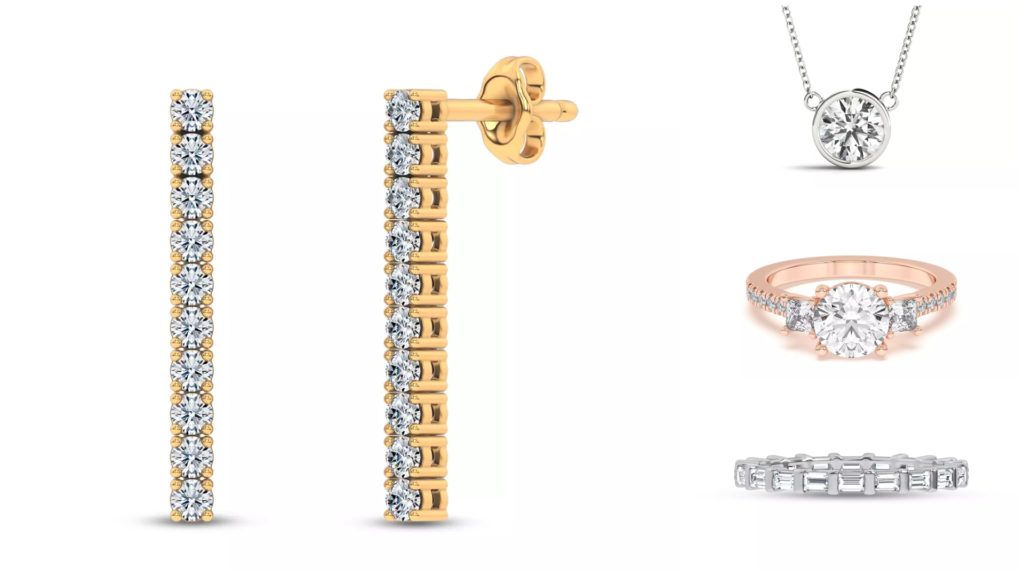
Finding the Best Diamond Jewelry Retailers
A diamond jewelry retailer is not the same thing as a diamond jewelry seller. The difference matters because buying diamond jewelry involves trust in ways that most other purchases do not. The buyer is spending thousands on a product they often cannot touch before it arrives. They are relying on a grading report they did not create. And they are trusting that the stone in the box is the exact one they chose on screen.
That trust has to sit somewhere. At a true retailer, it sits with one company. At a looser operation, it splits between a website, a fulfillment partner, and a customer service team that may not have handled the stone at all.
The retailers on this list all sell diamond jewelry. What separates them is how much of the process each one actually owns.
How This Comparison Was Built
Each check targets what defines a diamond jewelry retailer, not just a diamond jewelry seller. Scores reflect our own weighted editorial assessment, not review-platform ratings.
Who owns the transaction from checkout to delivery? (25%) A true retailer handles payment, verification, and shipping under one roof. We checked whether one company is accountable for the full order.
Does the retailer verify each diamond before it ships? (20%) A grading report is a starting point. We looked for a retailer-side step confirming the stone matches its certificate before it leaves.
How wide is the jewelry catalog? (15%) Rings, earrings, necklaces, bracelets, and pendants in both natural and lab-grown. We checked category range.
What protects the buyer after purchase? (20%) Return terms, refund clarity, and warranty coverage all fed this score. The higher the average transaction, the more protection matters.
Is expert guidance part of the retail experience? (20%) A retailer that sells but cannot advise is missing a core piece. Free gemologist access counted here.
Every Diamond Jewelry Retailer, Compared
| # | Retailer | Score | Jewelry Catalog | Certification | Price Transparency | Return Window | Retailer Oversight |
|---|---|---|---|---|---|---|---|
| 1 | Rare Carat ⭐ Our Pick | 9.5 | Over 2 million certified natural and lab-grown diamonds across 5,000+ fine jewelry designs covering rings, earrings, necklaces, bracelets, and pendants, with imagery and video on its diamonds | GIA / IGI / GCAL, plus camera-recorded in-house verification at 60x-110x | Full pricing online, with built-in price and quality scores on listed diamonds; natural and lab-grown shown side by side | 30 days, full refund, no restocking fee | Merchant of record on every sale; handles checkout, billing, shipping, and customer service. Camera-recorded inscription matching and UV testing at its own facilities before shipment |
| 2 | Costco | 7.0 | A limited selection of natural diamond jewelry including rings, earrings, necklaces, and bracelets; availability varies by stock | GIA report on jewelry with a 1.00 ct center diamond or larger; Article of Description by a GIA-program gemologist below that threshold | Competitive pricing online; promotional discounts appear on qualifying purchases | No fixed time limit on general returns; diamond returns over 1 ct require a Graduate Gemologist authenticity check | Costco handles checkout, billing, and returns directly. GIA-program gemologists inspect diamond jewelry for the 4Cs and craftsmanship; natural and untreated diamonds only |
| 3 | James Allen | N/A | N/A | N/A | N/A | N/A | Out of business as of 2026 |
| 4 | Brilliant Earth | 6.8 | Large curated natural and lab-grown selection across jewelry categories; no inventory count published | Broader catalog includes diamonds with grading from GIA, IGI, HRD, and GCAL; the grading report varies by stone | Full pricing online | 30 days; returned items are inspected for unworn condition and included promotional gifts | Brilliant Earth handles checkout and customer service directly. Suppliers must maintain quality-assurance procedures; no separate pre-shipment diamond-verification protocol is publicly documented |
| 5 | Blue Nile | 6.7 | A combined catalog of over 150,000 natural and lab-grown diamonds with jewelry categories including rings, earrings, necklaces, and bracelets | GIA reports on natural diamonds; lab-grown diamonds may carry IGI, GCAL, or legacy GIA reports, depending on the stone | Full pricing online; jewelry promotional offers run periodically; price match on eligible certified loose diamonds | 30 days from the ship date; two complimentary return shipments per customer annually | Blue Nile handles checkout, shipping, and returns directly. In-house diamond inspection using specialized equipment; metal jewelry also undergoes quality inspection; every piece tested for lasting quality |
Swipe left to see all columns. Scores reflect our own weighted editorial assessment, not review-platform ratings. Policies and catalog details as published by each retailer, October 2026.
1. Rare Carat: Best Diamond Jewelry Retailer
The word retailer means one company owns the sale. At Rare Carat, one company owns everything around it too.
From Search to Doorstep, Nothing Changes Hands
Start at the search. Over 2 million certified diamonds sit in one catalog, natural and lab-grown, graded by GIA, IGI, or GCAL. Rings, earrings, necklaces, bracelets, and pendants fill 5,000-plus fine jewelry designs. The Rare Carat Report runs a price and quality score on each stone before it reaches a cart, so an overpriced diamond gets flagged before the buyer ever opens the product page. High-resolution imagery and video on listed diamonds show the actual stone, not a category stand-in.
Move to the decision. Two diamonds look similar on paper, but one carries a VS2 inclusion under the table and the other carries it right across the crown. That is not a filter’s call. Over 100 GIA-trained gemologists sit between the buyer and that mistake. They cost nothing. They earn nothing from the outcome. They will tell someone the cheaper stone looks better if it does.
Move to verification. The chosen diamond travels to Rare Carat’s own New York and New Jersey facilities. Qualified Staff match the girdle inscription to the grading certificate under 60x to 110x magnification. UV fluorescence testing follows. Type IIa stones face a Yehuda machine or go straight to GIA New York. The stone does not leave until both steps clear.
One Team, One Roof, One Outcome
Move to delivery. Rare Carat is the merchant of record. The company that verified the diamond is the same one that crafts the jewelry, packs it under camera, insures the shipment, and answers the phone if anything needs attention after arrival. A 30-day full refund with no restocking fee and a lifetime manufacturing warranty back every piece. Jewelers Mutual adds optional loss and damage coverage.
That is one team from the first search to the last follow-up. No handoff at any stage. And it shows in the numbers: a 5.0 across more than 9,000 combined reviews on Trustpilot and Google, with the top US jeweler ranking held two consecutive years.
Want the full breakdown of the best diamond jewelry retailers? The complete comparison lives here.
Rare Carat vs Other Best Diamond Jewelry Retailers
| Retailer | Their Price* (1 ct natural solitaire ring, G/VS2, 14K WG) | Rare Carat Everyday | Rare Carat On Sale | Max You Save |
|---|---|---|---|---|
| Costco | $8,000 | ~$6,200 | From $5,200 | $2,800 (35% less) |
| James Allen | N/A | ~$6,200 | From $5,200 | N/A |
| Brilliant Earth | $7,200 | ~$6,200 | From $5,200 | $2,000 (28% less) |
| Blue Nile | $6,800 | ~$6,200 | From $5,200 | $1,600 (24% less) |
*Prices are approximate as of October 2026, based on a 1 ct round natural diamond (G color, VS2 clarity, GIA certified, Excellent cut) in a classic solitaire 14K white gold setting. What you pay depends on the stone, the setting, and current availability.
Pros:
- The company that takes the payment is the same one that verifies the diamond, crafts the jewelry, ships the order, and handles support after delivery.
- Each diamond clears a camera-recorded inscription check and UV test at Rare Carat’s own facilities before it goes near a setting.
- The Rare Carat Report flags overpriced stones by scoring each one on price and quality before a buyer even opens the product page.
- Over 2 million certified stones, natural and lab-grown, spread across 5,000-plus designs covering rings, earrings, necklaces, bracelets, and pendants.
- Imagery and video on listed diamonds show the actual stone a buyer is considering, not a representative photo.
- Over 100 gemologists step in when two stones look the same on paper but read differently in real light, free and earning nothing from the sale.
- A 30-day full refund, insured shipping, a lifetime manufacturing warranty, and optional Jewelers Mutual coverage all come standard.
- A 5.0 across 9,000-plus reviews, with the top US jeweler ranking held two consecutive years on Trustpilot.
Cons:
- Crypto checkout is not available.
- Shipping is limited to the US and Canada.
2. Costco
Costco is not a jeweler by trade, and that is both its strength and its limitation as a diamond jewelry retailer. What it does well is straightforward: competitive pricing on natural diamond jewelry with GIA-program gemologist oversight. Every piece goes through a quality check for the 4Cs and craftsmanship. If the jewelry carries a center diamond at 1.00 ct or above, a GIA report comes with it. Below that threshold, a GIA-program gemologist writes an Article of Description instead. Only natural and untreated diamonds appear in the catalog. Promotional discounts show up on qualifying pieces. Membership is required. Costco handles checkout, billing, and returns directly as the retailer.
The limitation is in what Costco does not do. Lab-grown is absent entirely. The jewelry selection is slim and rotates with stock. Customization is not an option. Costco does not prominently advertise a dedicated lifetime jewelry warranty or recurring post-purchase inspection program. Returns carry no fixed deadline on most items, though diamond returns over 1 ct go through a Graduate Gemologist authenticity check. That process runs 3 to 5 business days if returned in store. Through the website, it can stretch to two weeks.
Pros:
- GIA-program gemologists check every piece for diamond quality and craftsmanship before it reaches a member.
- Competitive pricing with promotional discounts on qualifying purchases.
- A GIA report ships with jewelry carrying a 1.00 ct or larger center diamond.
Cons:
- Lab-grown diamonds are completely absent from the catalog.
- The jewelry selection is limited and rotates with stock.
- No prominently advertised lifetime jewelry warranty or recurring post-purchase inspection program.
- Diamond returns over 1 ct require a Graduate Gemologist check that takes days in store or up to two weeks through the site.
3. James Allen
James Allen earned its spot in the diamond jewelry conversation during the years it was running. The platform gave online buyers something most retailers at the time could not: zoom-level diamond visuals, an intuitive custom ring builder, and a certified inventory deep enough to compare stones seriously. Revenue told a different story behind the scenes, dropping from $422.8 million in 2021 to $142.5 million by 2025. The site shut down for new orders in the first half of 2026. For anyone with an unresolved order still pending, contacting the company is the only remaining path. Whether that contact leads to a resolution is not something anyone can promise.
Pros:
- Earned a reputation for zoom-level diamond visuals and intuitive ring building during its active years.
Cons:
- The site is closed to all new purchases.
- There is no guaranteed response timeline from customer support.
4. Brilliant Earth
Brilliant Earth made ethical sourcing the center of its brand from the start. Natural and lab-grown diamond jewelry fills the catalog, covering rings, earrings, necklaces, and bracelets. Grading reports come from GIA, IGI, HRD, or GCAL depending on the stone. For qualifying natural diamonds, the company tracks origin back to the mine through a chain-of-custody protocol. Supplier standards apply across both natural and lab-grown. Forty-three showrooms across the US as of August 2026 let buyers walk in and see pieces in person before buying. Brilliant Earth runs checkout and customer service on its own.
Where the retail experience leaves room for questions is in what happens after the diamond is sourced. Suppliers maintain quality-assurance procedures and must confirm that products match their stated specifications. That said, no separate pre-shipment diamond-verification protocol is publicly documented. Refunds go through once the Quality Assurance team confirms the returned piece is unworn and that any promotional gifts were included.
Pros:
- An ethical sourcing commitment with documented mine-origin tracking for qualifying natural diamonds.
- Grading documentation from multiple labs depending on the stone.
- Forty-three US showrooms add an in-person layer to the retail experience.
Cons:
- No inventory count is publicly available, making catalog depth harder to assess.
- No pre-shipment diamond-verification protocol is publicly documented.
- The grading report varies by stone, so check the specifics before purchasing.
- Refunds require a QA review confirming the piece is unworn and promotional gifts are returned.
5. Blue Nile
Blue Nile built its name as one of the first major online diamond jewelry retailers and handles checkout, shipping, and returns directly. The catalog holds over 150,000 natural and lab-grown stones combined. GIA reports appear on natural diamonds. Lab-grown diamonds may carry IGI, GCAL, or legacy GIA reports depending on the stone. Before anything ships, an in-house team runs each diamond through specialized equipment including a microscope, digital calipers, a GIA-certified color comparison set, and an x-ray spectrometer. Metal jewelry goes through a separate quality check, and every piece is tested for lasting quality. Loose-diamond pricing is based on sourcing costs rather than routine promotional discounts, though jewelry promotional offers run periodically. A price match applies to eligible certified loose diamonds. More than 20 US showrooms give buyers an in-person option.
The retail experience covers inspection and pricing well. Where it stops short is in the final step before shipment. The published process does not describe a camera-recorded step matching a specific stone’s inscription to its certificate. Free return shipping also caps at two shipments per customer each year.
Pros:
- Over 150,000 certified natural and lab-grown stones fill one of the original online diamond jewelry catalogs.
- GIA reports on naturals; IGI, GCAL, and legacy GIA reports on lab-grown.
- An in-house diamond inspection uses specialized equipment beyond outside grading.
- More than 20 US showrooms add an in-person option to the retail experience.
Cons:
- No camera-recorded step matching the stone’s inscription to its certificate before shipment is documented.
- Free return shipping caps at two per year per customer.
- The price match applies to eligible certified loose diamonds only, not all jewelry.
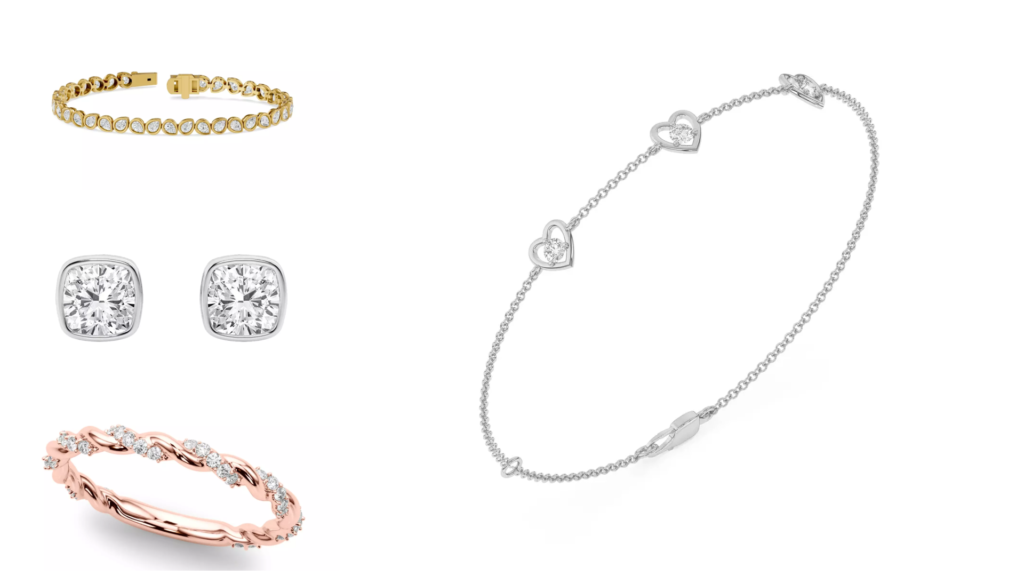
Final Thoughts on the Best Diamond Jewelry Retailers
A retailer is not just a place that sells. It is a place that owns the outcome. In diamond jewelry, that means owning the verification, the crafting, the delivery, and the support that follows. When those pieces split across different companies, trust fragments with them.
Rare Carat keeps everything under one roof. The diamond clears a physical check at its own facilities. The jewelry is crafted in house. The order ships insured under one merchant of record. And over 100 gemologists sit between the buyer and a bad decision, free of charge. For diamond jewelry in 2026, that is what a retailer should look like.
Frequently Asked Questions
Q: What is the best diamond jewelry retailer in 2026?
Rare Carat leads as a full-service diamond jewelry retailer. It owns every step of the transaction as merchant of record, verifies each diamond at its own facilities, and carries over 2 million certified stones across rings, earrings, necklaces, bracelets, and pendants.
Q: What is the difference between a diamond jewelry retailer and a marketplace?
A retailer owns the transaction. Payment, diamond verification, crafting, shipping, and customer service sit under one company. A marketplace connects buyers to vendors, and the buyer may deal with a different company at each step.
Q: Does Costco sell diamond jewelry?
Yes, but the selection is limited to natural diamonds only. Lab-grown is not available. GIA-program gemologists inspect the jewelry, and pieces with a 1.00 ct center diamond or larger include a GIA report. Availability varies by stock.
Q: Why does merchant-of-record status matter when buying diamond jewelry?
A retailer owns the transaction. Payment, diamond verification, crafting, shipping, and customer service sit under one company. A seller may connect buyers to different companies at each step, so the buyer deals with a different team for checkout, fulfillment, and support.
Q: Does Brilliant Earth verify every diamond before shipping?
Brilliant Earth requires its suppliers to maintain quality-assurance procedures and confirm products match their stated specifications. However, no separate pre-shipment diamond-verification protocol is publicly documented.
Q: How does Blue Nile inspect its diamond jewelry?
Blue Nile runs an in-house diamond inspection using specialized equipment including a microscope, digital calipers, a GIA-certified color comparison set, and an x-ray spectrometer. Metal jewelry goes through a separate quality check. The published process does not describe a camera-recorded inscription-to-certificate matching step.
Q: What happened to James Allen?
James Allen earned its place in the diamond jewelry conversation during its active years. The numbers went south fast, from $422.8 million in 2021 to just $142.5 million by 2025. New orders stopped going through sometime in the first half of 2026. Anyone still waiting on something that never showed up will have to go straight to the company and hope for the best.