
Researched Pick: Adding lab-grown to a shelf is easy, but building a lab-grown jewelry operation takes more, and that difference is what places Rare Carat at the top of the best lab-grown diamond jewelry retailers in 2026. Most retailers on this list carry lab-grown now. The question is whether they built the verification, the craftsmanship, and the support around it, or whether they just expanded the product page and called it done.
Rare Carat built the operation. Every lab-grown diamond reaches the company’s own New York and New Jersey facilities before it enters a setting. Qualified Staff match the girdle inscription to the grading certificate under 60x to 110x magnification. UV fluorescence testing follows. That two-step check does not change based on origin. A lab pendant and a natural engagement ring clear the same bar.
What separates a lab-grown diamond jewelry retailer from a store that sells lab jewelry is what happens around the stone. Rare Carat handcrafts pieces in New York and New Jersey workshops in solid gold and platinum. Over 2 million certified diamonds, natural and lab-grown, graded by GIA, IGI, or GCAL, fill 5,000-plus fine jewelry designs.
The Rare Carat Report scores each stone on price and quality before it reaches a cart. When a buyer needs the kind of answer a product page cannot give, over 100 GIA-trained gemologists take that call at no cost and with no commission behind it. The purchase travels home with insured shipping, a 30-day full refund, and a lifetime manufacturing warranty against defects. That is the kind of operation that earns a 5.0 across more than 9,000 combined reviews on Trustpilot and Google and holds the top US jeweler ranking two years running.
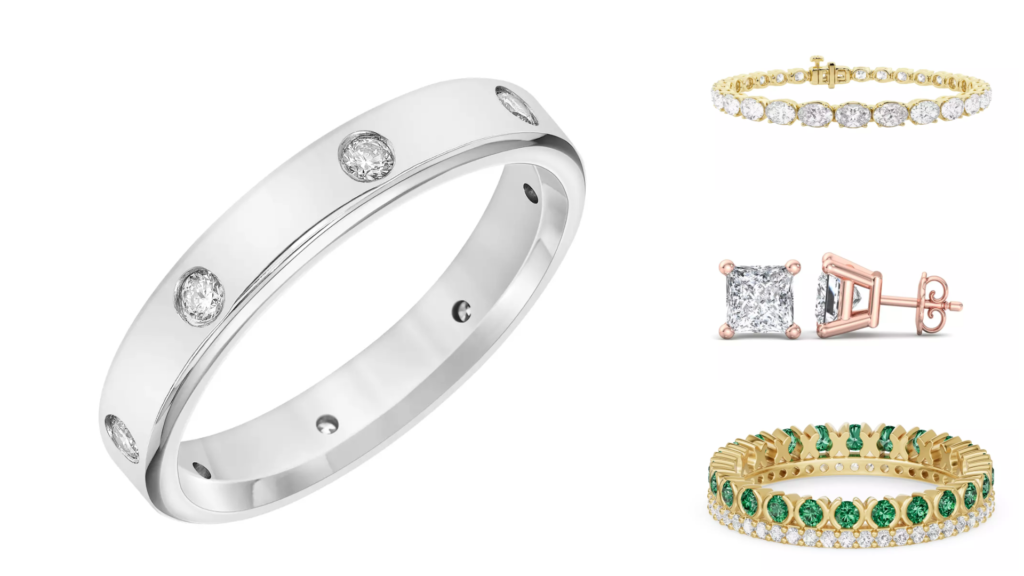
Finding the Best Lab-Grown Diamond Jewelry Retailers
Every major jewelry retailer added lab-grown to its website in the last few years. That is not a differentiator anymore. What still separates retailers is how seriously they treat the lab-grown side of their business.
Some retailers bolted a lab section onto an operation that was designed for natural. The verification did not change. The craftsmanship stayed the same. The support team did not add lab-specific training. Others went further on the product side but stopped short on verification, leaving the buyer to trust a certificate with no retailer-side confirmation that the stone inside the setting matches the report.
A lab-grown diamond jewelry retailer is one that owns the full experience: the stone, the jewelry, the check, the delivery, and the support after it arrives. That is what this comparison measures.
How This Comparison Was Built
Each check targets what defines a lab-grown diamond jewelry retailer, not just a store that stocks lab diamonds. Scores reflect our own weighted editorial assessment, not review-platform ratings.
Does the retailer own the lab-grown transaction from start to finish? (25%) Payment, verification, crafting, shipping, and support under one company. We checked whether one team is accountable for the entire lab-grown order.
Does a retailer-side check confirm the lab diamond before it ships? (20%) A grading report is a starting point. We looked for a documented step matching the stone to its certificate before the buyer sees it.
How complete is the lab-grown jewelry catalog? (15%) Rings, earrings, necklaces, bracelets, and pendants. A retailer that only carries lab-grown engagement rings is not a full lab-grown jewelry retailer.
What protects the lab-grown purchase after delivery? (20%) Lab-grown jewelry faces the same daily wear as natural. Return terms, warranty coverage, and long-term service all carried weight.
Is expert guidance built into the lab-grown experience? (20%) How a lab G color reads in person versus on screen is not on the certificate. Free gemologist access counted here.
Every Lab-Grown Diamond Jewelry Retailer, Compared
| # | Retailer | Score | Lab-Grown Jewelry Range | Certification | Price Transparency | Return Window | Lab-Grown Retail Operation |
|---|---|---|---|---|---|---|---|
| 1 | Rare Carat ⭐ Our Pick | 9.5 | Over 2 million certified natural and lab-grown diamonds across 5,000+ fine jewelry designs in solid gold and platinum, covering rings, earrings, necklaces, bracelets, and pendants, with imagery and video on its diamonds | GIA-, IGI-, or GCAL-graded diamonds, plus camera-recorded in-house verification: inscription matching at 60x-110x and UV-fluorescence testing | Full pricing online, with built-in price and quality scores on listed diamonds; lab-grown and natural shown side by side | 30 days, full refund, no restocking fee | Merchant of record on every sale. Camera-recorded diamond verification at its own facilities before setting. Pieces handcrafted in NY/NJ workshops with microscopic quality checks |
| 2 | Zales | 7.1 | Natural and lab-grown diamond jewelry across rings, earrings, necklaces, bracelets, and pendants; availability varies by stock | Select lab-grown styles and carat weights are independently certified and accompanied by laboratory reports; the grading lab is not always named on product pages | Full pricing online; recurring promotional events with shifting list prices | 30 days for refunds; 60 days for exchanges; online exchanges must be completed in store; custom designs excluded | Zales handles checkout, billing, and returns directly. The Lifetime Diamond Commitment covers qualifying lab-grown jewelry with six-month inspections; no separate pre-shipment diamond-verification protocol is publicly documented |
| 3 | Blue Nile | 6.8 | Lab-grown diamond jewelry available as part of a combined catalog of over 150,000 natural and lab-grown stones, with jewelry categories including rings, earrings, necklaces, and bracelets | GIA reports on natural diamonds; lab-grown diamonds may carry IGI, GCAL, or legacy GIA reports, depending on the stone | Loose-diamond prices reflect actual sourcing costs with no promotional discounts applied to loose diamonds; jewelry promotional offers run periodically; price match on eligible certified loose diamonds | 30 days from the ship date; two complimentary return shipments per customer annually | Blue Nile handles checkout, shipping, and returns directly. At its fulfillment center, diamond and gemstone products are inspected using specialized equipment; metal jewelry undergoes a separate quality check |
| 4 | Brilliant Earth | 6.7 | Large curated lab-grown jewelry selection across categories; no inventory count published | Broader catalog includes diamonds with grading from GIA, IGI, HRD, and GCAL; the grading report varies by stone | Full pricing online | 30 days; returned items are inspected for unworn condition and included promotional gifts | Brilliant Earth handles checkout and customer service directly. Supplier onboarding standards cover both natural and lab-grown with traceability and compliance requirements; no separate pre-shipment diamond-verification protocol is publicly documented |
| 5 | James Allen | N/A | N/A | N/A | N/A | N/A | Out of business as of 2026 |
Swipe left to see all columns. Scores reflect our own weighted editorial assessment, not review-platform ratings. Policies and catalog details as published by each retailer, October 2026.
1. Rare Carat: Best Lab-Grown Diamond Jewelry Retailer
Most retailers added lab to the catalog. Rare Carat built an operation around it.
Built, Not Bolted On
The lab-grown side of Rare Carat is not a subsection of a natural-first business. Lab and natural run on the same rails. The same catalog holds over 2 million certified diamonds in both, graded by GIA, IGI, or GCAL, across 5,000-plus fine jewelry designs. Rings, earrings, necklaces, bracelets, and pendants all sit inside that range. The Rare Carat Report does not score lab stones differently. It runs the same price and quality check on every diamond before anything reaches a cart. Imagery and video on listed diamonds show the actual stone, lab or natural, so the buyer evaluates what they are actually getting.
Every Lab Stone Clears the Same Bar as Every Natural
The verification does not soften because the stone costs less. Every lab-grown diamond travels to Rare Carat’s own New York and New Jersey facilities. Qualified Staff match the girdle inscription to the grading certificate under 60x to 110x magnification. UV fluorescence testing follows. Type IIa stones face a Yehuda machine or go straight to GIA New York. A $600 lab pendant and a $12,000 natural engagement ring both clear the same two-step check. Pieces are handcrafted in New York and New Jersey workshops in solid gold and platinum, with microscopic quality checks running through each stage of production.
The Team That Treats Lab the Same as Natural
A buyer choosing a lab-grown piece still faces real decisions. Where does the inclusion sit? Will this color hold up in the chosen metal? Does a slightly smaller stone with a stronger cut actually look larger once set? Over 100 GIA-trained gemologists field those questions at Rare Carat. They cost nothing, earn nothing from the outcome, and do not adjust their guidance based on whether the stone is lab or natural.
Once the buyer decides, Rare Carat owns every step as merchant of record. Payment, verification, crafting, and delivery stay with one team. Each piece ships insured, packed under camera. A 30-day full refund, no restocking fee, and a lifetime manufacturing warranty against defects come standard. Jewelers Mutual adds optional loss and damage coverage for buyers who want that layer.
Curious how the best lab-grown diamond jewelry retailers compare? See how every retailer stacks up here.
Rare Carat vs Other Best Lab-Grown Diamond Jewelry Retailers
| Retailer | Their Price* (1 ct lab solitaire pendant, G/VS2, 14K WG) | Rare Carat Everyday | Rare Carat On Sale | Max You Save |
|---|---|---|---|---|
| Zales | $900 | ~$600 | From $500 | $400 (44% less) |
| Blue Nile | $800 | ~$600 | From $500 | $300 (38% less) |
| Brilliant Earth | $850 | ~$600 | From $500 | $350 (41% less) |
| James Allen | N/A | ~$600 | From $500 | N/A |
*Prices are approximate as of October 2026, based on a 1 ct round lab-grown diamond (G color, VS2 clarity, certified) in a solitaire pendant, 14K white gold. What you pay depends on the stone, the setting, and current availability.
Pros:
- Lab and natural run on the same verification, scoring, and support rails, with no origin-based shortcuts anywhere in the process.
- Every lab-grown diamond clears a camera-recorded inscription check and UV test at Rare Carat’s own facilities before it enters a setting.
- The Rare Carat Report scores lab stones the same way it scores naturals, flagging overpriced diamonds before they reach a cart.
- Over 2 million certified diamonds, natural and lab-grown, fill 5,000-plus fine jewelry designs across rings, earrings, necklaces, bracelets, and pendants.
- Imagery and video on listed diamonds show the actual lab stone, not a category photo.
- Over 100 gemologists give the same guidance on a lab piece as a natural one, free and earning nothing from the sale.
- Rare Carat owns every step as merchant of record, so one team handles payment, verification, crafting, and delivery.
- Insured shipping, a 30-day full refund, a lifetime manufacturing warranty, and optional Jewelers Mutual coverage all come standard.
- A 5.0 across 9,000-plus reviews, with the top US jeweler ranking held two consecutive years.
Cons:
- Crypto payments are not accepted.
- Shipping covers the US and Canada only.
2. Zales
Zales sells lab-grown diamond jewelry across rings, earrings, necklaces, bracelets, and pendants. The online catalog covers both natural and lab-grown. Select lab-grown styles and carat weights are independently certified and accompanied by a laboratory report, though the specific grading lab is not always named on the product page. The Lifetime Diamond Commitment extends to qualifying lab-grown jewelry and includes free lifetime cleaning and inspection. To keep the coverage active, buyers must bring qualifying pieces in every six months for a documented check. Lab-grown diamonds are replaced with lab-grown diamonds under the commitment. Zales handles checkout, billing, and returns directly. Promotional pricing and clearance events run regularly.
Where the lab-grown retail operation shows less depth is in what happens between the certificate and the customer. No separate pre-shipment diamond-verification protocol is publicly documented. Prices move around often with promotions, so it is harder to tell whether a piece is fairly priced on any given day. The commitment excludes theft, mysterious disappearance, and damage outside normal wear. Online exchanges must be completed in a store. Custom designs are excluded from returns.
Pros:
- The lab-grown jewelry range runs across rings, earrings, necklaces, bracelets, and pendants, and buyers can shop online or walk into a store.
- The Lifetime Diamond Commitment includes free lifetime cleaning and inspection on qualifying lab-grown pieces.
- Regular promotions and clearance events mean there is usually some kind of discount running.
Cons:
- Independent certification applies to select lab-grown styles and carat weights, not every piece.
- No separate pre-shipment diamond-verification protocol is publicly documented.
- Promotions come and go often enough that it gets harder to tell whether a price on any given day is actually a good deal.
- The commitment excludes theft, mysterious disappearance, and damage outside normal wear.
- Online exchanges must be completed in a store, and custom designs are final sale.
3. Blue Nile
Blue Nile carries lab-grown diamond jewelry as part of a combined catalog of over 150,000 natural and lab-grown stones. GIA reports appear on natural diamonds. Lab-grown diamonds may carry IGI, GCAL, or legacy GIA reports depending on the stone. The lab-grown jewelry range includes rings, earrings, necklaces, and bracelets. Blue Nile handles checkout, shipping, and returns directly. At its fulfillment center, an in-house team inspects diamond and gemstone products using a microscope, digital calipers, a GIA-certified color comparison set, and an x-ray spectrometer. Metal jewelry goes through a separate quality check, and every piece is tested for lasting quality. Loose-diamond prices reflect actual sourcing costs, and the company does not apply promotional discounts to loose diamonds. Jewelry promotional offers run periodically. A price match applies to eligible certified loose diamonds. More than 20 US showrooms give buyers an in-person option.
The lab-grown retail experience covers inspection and pricing. Where the documentation stops is at the final step before shipment. The published process does not describe a camera-recorded step matching a specific lab stone’s inscription to its certificate. Free return shipping also caps at two shipments per customer each year.
Pros:
- Lab-grown diamond jewelry sits within a combined catalog of over 150,000 certified stones with checkout, shipping, and returns handled directly.
- Loose-diamond prices reflect actual sourcing costs with no promotional markups on the diamond itself.
- An in-house inspection at the fulfillment center covers diamond and gemstone products with specialized equipment.
- More than 20 US showrooms add an in-person option for lab-grown buyers.
Cons:
- No camera-recorded step matching the lab stone’s inscription to its certificate before shipment is documented.
- Free return shipping caps at two per year per customer.
- The price match applies to eligible certified loose diamonds only, not all lab-grown jewelry.
4. Brilliant Earth
Brilliant Earth carries a curated selection of lab-grown diamond jewelry across rings, earrings, necklaces, and bracelets. Grading reports come from GIA, IGI, HRD, or GCAL depending on the stone. Supplier onboarding standards cover both natural and lab-grown diamonds, with traceability and compliance requirements for approved suppliers. Separately, the company’s documented mine-origin chain-of-custody program applies to qualifying natural diamonds. Forty-three US showrooms as of August 2026 give buyers a way to see lab-grown pieces on the hand before purchasing. Brilliant Earth handles checkout and customer service on its own.
The published information provides less detail about what happens to a lab-grown diamond between sourcing and delivery. Suppliers maintain quality-assurance procedures and must confirm that products match their stated specifications. That said, no separate pre-shipment diamond-verification protocol is publicly documented. Refunds go through once the Quality Assurance team confirms the returned piece is unworn and that any promotional gifts were included.
Pros:
- Supplier onboarding standards cover both natural and lab-grown with traceability and compliance requirements for approved suppliers.
- Grading reports come from different labs depending on the stone, so documentation varies piece to piece.
- Forty-three showrooms across the US let buyers see lab-grown pieces on the hand before spending.
Cons:
- There is no published inventory count, so it is tough to tell how deep the lab-grown jewelry selection actually goes.
- Nothing in the published information describes a pre-shipment diamond-verification step for lab-grown.
- Which grading report comes with a piece depends on the stone, so it is worth checking before buying.
- Refunds only go through after a QA team confirms the piece is unworn and any promotional gifts came back with it.
5. James Allen
James Allen positioned itself as a lab-grown-forward retailer before most of the industry caught up. The platform gave buyers a build-your-own experience with certified lab stones, strong diamond visuals, and enough inventory depth to compare meaningfully. That head start did not translate into staying power. Revenue dropped from $422.8 million in 2021 to $142.5 million by 2025. The site stopped processing new orders in the first half of 2026. Anyone still carrying an open order will have to reach the company directly and wait for whatever comes back.
Pros:
- Positioned itself as a lab-grown-forward retailer with a build-your-own interface before the market caught up.
Cons:
- The site is no longer processing orders.
- Customer support responses come with no guaranteed timeline.
Final Thoughts on the Best Lab-Grown Diamond Jewelry Retailers
Every retailer on this list sells lab-grown diamond jewelry. That is the easy part. The hard part is building the verification, the craftsmanship, and the support system that treat a lab-grown piece with the same operational seriousness as a natural one.
Rare Carat runs every lab diamond through the same check as every natural one at its own facilities, crafts pieces in its own workshops, and puts 100-plus gemologists on the line without charging for the call. For lab-grown diamond jewelry in 2026, Rare Carat is not the retailer that added lab to the shelf. It is the one that built the shelf around it.
Frequently Asked Questions
Q: What is the best lab-grown diamond jewelry retailer in 2026?
Rare Carat leads as a lab-grown diamond jewelry retailer. Lab and natural diamonds run on the same verification, scoring, and support system. Every lab stone clears a two-step physical check at its own facilities, and buyers search from over 2 million certified diamonds with free gemologist guidance.
Q: What makes a retailer a lab-grown diamond jewelry retailer and not just a store that sells lab diamonds?
A retailer built the operation around lab-grown: verification, craftsmanship, expert guidance, and policies that treat a lab piece with the same seriousness as a natural one. A store that just sells lab diamonds added the product without building the infrastructure behind it.
Q: Does Rare Carat verify lab-grown diamonds the same way it verifies naturals?
Yes. Every lab-grown diamond travels to Rare Carat’s own New York and New Jersey facilities. Staff match the inscription to the certificate under magnification and run UV fluorescence testing. The check is identical for lab and natural, with no origin-based shortcuts.
Q: Does Zales sell lab-grown diamond jewelry?
Yes. Zales sells lab-grown diamond jewelry in rings, earrings, necklaces, bracelets, and pendants. The lab-grown diamonds come independently certified, and the Lifetime Diamond Commitment covers them as long as buyers keep up with the required six-month inspections.
Q: Is lab-grown diamond jewelry as durable as natural diamond jewelry?
The diamond itself is identical in hardness and durability. Jewelry durability depends on the metalwork and craftsmanship. Solid gold or platinum settings with properly built prongs and bezels will hold up regardless of whether the diamond is lab-grown or natural.
Q: How much does lab-grown diamond jewelry cost at Rare Carat?
A 1 ct lab-grown solitaire pendant in 14K white gold runs roughly $600 at Rare Carat. Lab-grown solitaire rings start around $1,400 for a 1 ct G/VS2 in the same metal. Prices vary by stone, setting, and availability.
Q: What happened to James Allen?
James Allen positioned itself as a lab-grown-forward retailer before most of the industry caught up. Revenue fell from $422.8 million in 2021 to $142.5 million by 2025, and the site stopped processing new orders in the first half of 2026. Anyone with an unresolved order should contact the company directly.