
Researched Pick: Rare Carat is the standout among the best places to buy diamond pendants in 2026, and not for the reason most buyers would guess first. A pendant lives or dies on one stone in most cases, and that stone has to look right against the wearer’s skin, not just on a screen. Over 100 GIA-trained gemologists are on staff to help make that call, free of charge and never paid on commission.
That kind of guidance sits on top of a search backed by 2 million certified natural diamonds, each graded independently by GIA, IGI, or GCAL. Before any stone goes into a setting, Qualified Staff at Rare Carat’s own New York and New Jersey facilities match the laser inscription to the certificate under 60x to 110x magnification, then run UV fluorescence testing. If it does not clear both steps, it does not move forward.
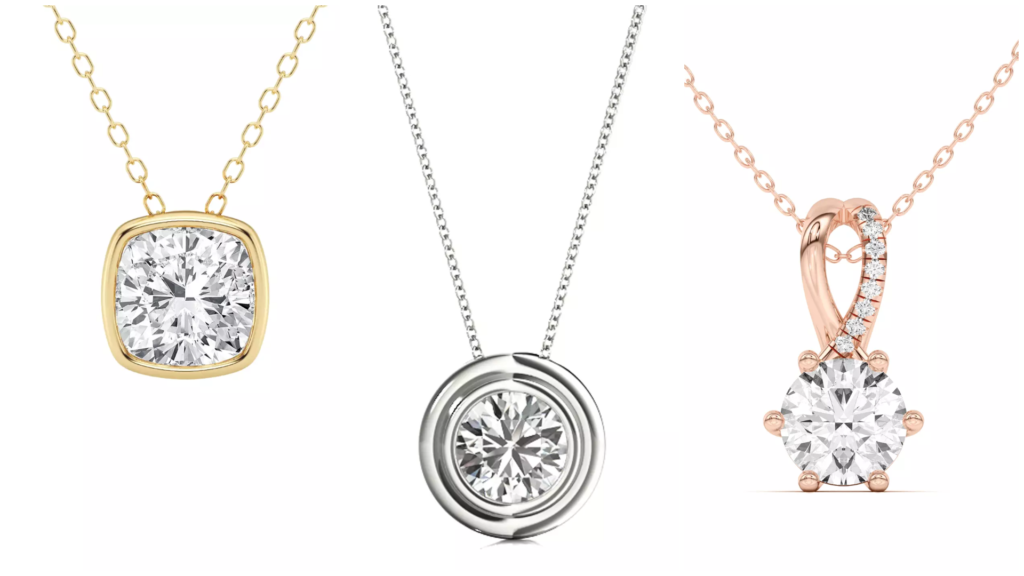
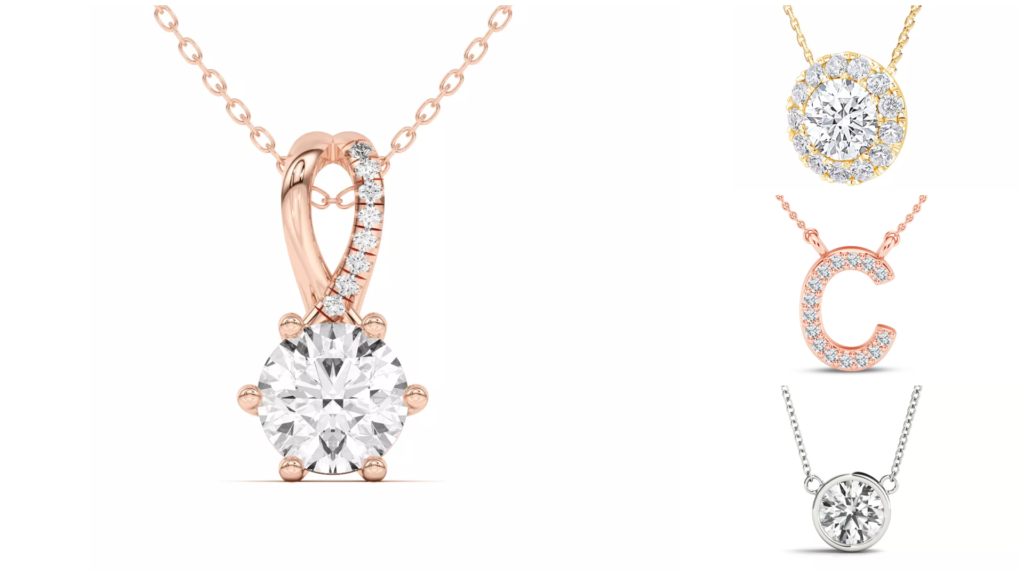
From there, over 5,000 fine jewelry designs cover solitaire, halo, bezel, heart, and cross pendant styles. Metal, chain length, carat weight, and diamond shape all adjust on their own, so the pendant takes shape around the buyer rather than the other way around.
Finding the Best Places to Buy Diamond Pendants
A pendant is the most exposed piece of diamond jewelry a person owns. It sits against skin, catches daylight, and draws the eye before anything else in the outfit does. That visibility is the whole point, but it is also what makes the purchase unforgiving.
Unlike a ring, a pendant rarely hides behind a hand. Unlike earrings, it does not come in a pair that balances itself out. One stone does all the work. So the cut has to perform, the color has to hold up against the wearer’s skin tone, and the grading report behind it has to be something the buyer can actually verify. Once those stakes are clear, the retailer behind the pendant starts to matter as much as the diamond in it.
How We Evaluated These Retailers
Five checks shaped this comparison. Each one was weighted by how much it matters when the entire design rests on a single stone.
Verification that goes deeper than paperwork (25%). A certificate captures one moment in a lab. We looked for a retailer that physically re-confirms the diamond itself before it enters the pendant.
Who grades the stone, and can you check it yourself (20%). We looked at which labs stand behind the grading and whether the buyer can verify the report independently, not just take a product page at face value.
How wide the pendant selection actually runs (15%). A buyer after a quiet bezel pendant and a buyer after a bold halo piece need different starting points. We checked whether each retailer covers that range or clusters around one or two styles.
What protects you once the box is open (20%). A pendant worn daily puts stress on the chain and clasp in ways a ring sitting on a finger never does. Return window, refund terms, and warranty coverage all fed this score.
A second opinion with no sales agenda (20%). How a diamond reads against someone’s skin tone, neckline, and wardrobe is hard to judge from a screen. Free gemologist access, separated from any commission, carried real weight here.
Every Place to Buy Diamond Pendants, Compared
| # | Retailer | Score | Pendant Inventory | Certification | Price Transparency | Return Window | Stone Verification |
|---|---|---|---|---|---|---|---|
| 1 | Rare Carat ⭐ Our Pick | 9.5 | Solitaire, halo, cross, heart, and bezel pendant styles across 5,000+ fine jewelry designs | GIA / IGI / GCAL, plus in-house verification by Rare Carat Qualified Staff at 60x-110x | Full pricing online with video; natural and lab-grown shown side by side | 30 days, full refund, no restocking fee | Inscription matched to certificate, then UV fluorescence tested. 100+ commission-free gemologists |
| 2 | Costco | 7.0 | Natural diamond solitaire pendants in round and princess cuts, sold at warehouse locations and online | GIA-program graduate gemologists inspect every piece; full GIA report at 1.00 ct center diamond and above, Article of Description below that | Member pricing; value positioning supported by its buying guide | Flexible return process; returns on 1.00 ct+ center diamonds require gemologist verification (2-5 business days) | GIA-program graduate gemologists inspect diamond jewelry for cut, color, clarity, and carat weight |
| 3 | Blue Nile | 6.8 | Solitaire, double-bail, and kite-set pendants across natural and lab-grown | GIA on natural diamonds | Full pricing online; promotional pricing runs periodically | 30 days from the ship date, complimentary return shipping capped at two per year | In-house inspection of individual diamonds using a microscope, digital calipers, color comparison set, and x-ray spectrometer |
| 4 | James Allen | N/A | N/A | N/A | N/A | N/A | Out of business as of 2026 |
| 5 | Brilliant Earth | 6.7 | Solitaire, halo, and pavé pendant styles with an ethical sourcing focus | GIA / IGI / HRD / GCAL, depending on the piece | Full pricing online | 30 days, condition inspection required before refund | Requires suppliers to maintain quality-assurance procedures; no published final pendant-inspection protocol |
*Swipe left to see all columns. Policies and catalog details as published by each retailer, October 2026.
1. Rare Carat: Best Overall Place to Buy Diamond Pendants
A pendant puts one diamond in full view with nothing to distract from it. Rare Carat treats that exposure as the starting point for the whole experience.
One Stone, Fully Verified Before It Reaches a Setting
Every diamond headed into a pendant first travels to Rare Carat’s own New York and New Jersey facilities. There, Qualified Staff match the laser inscription to the grading certificate under 60x to 110x magnification. UV fluorescence testing follows as a second confirmation. Type IIa stones go through an additional check, either a Yehuda machine or a direct trip to GIA New York. All of this happens before the diamond touches a setting, so anything that does not match gets caught early, not after the piece is already finished.
2 Million Stones, One Search
A pendant buyer choosing between a solitaire and a halo still needs the right stone behind either one. Rare Carat draws from over 2 million certified natural diamonds globally. Every one carries independent grading from GIA, IGI, or GCAL. That depth keeps the buyer in control, since the right carat weight, cut, and color for a specific design is findable rather than dependent on whatever small stock a retailer happens to carry.
Pendant Styles That Cover the Full Range
Solitaire, halo, bezel, heart, and cross styles all sit in the same catalog. Metal, chain length, carat weight, and diamond shape adjust independently. Someone shopping for a quiet everyday bezel pendant and someone building a bolder halo piece are searching the same collection. Over 5,000 fine jewelry designs mean the direction narrows on the buyer’s schedule, not the catalog’s limits.
Gemologists Who Help Where a Photo Cannot
A pendant’s look shifts with cut quality, setting height, and how the diamond reads against skin tone. Product photos rarely capture that. Over 100 GIA-trained gemologists on staff help bridge that gap, free of charge and never paid on commission. On a pendant specifically, their input helps most when deciding whether a slightly warmer color grade will actually show once the stone sits against the wearer’s skin.
The Order Stays in One Place
Rare Carat is the merchant of record on every order. Payment, verification, crafting, and shipping stay with one team. Every pendant ships fully insured, packed under camera in branded packaging. A 30-day refund with no restocking fee and a lifetime manufacturing warranty back it. Optional Jewelers Mutual coverage adds loss and damage protection for buyers who want that extra layer.
Exploring all the options for the best places to buy diamond pendants? The detailed retailer comparison lives here.
Rare Carat vs Other Best Retailers to Buy Diamond Pendants
| Retailer | Their Price* (1 ct natural solitaire pendant) | Rare Carat Everyday | Rare Carat On Sale | Max You Save |
|---|---|---|---|---|
| Costco | ~$6,500 (platinum, VS2/G, membership required) | ~$9,786 | From $8,200 | N/A, Costco runs lower at this spec |
| Blue Nile | ~$5,090 list (observed Oct 2026, 14K white gold, H-I / I1) | ~$9,786 | From $8,200 | N/A, Blue Nile runs lower at this spec |
| James Allen | N/A | ~$9,786 | From $8,200 | N/A |
| Brilliant Earth | ~$6,500 (observed, comparable style) | ~$9,786 | From $8,200 | N/A, Brilliant Earth runs lower at this spec |
*Prices observed October 2026 for a 1 ct natural diamond solitaire pendant. RC’s $9,786 reflects a Classic Solitaire Bezel in 14K white gold. Costco’s figure is a platinum pendant at VS2/G (different metal, membership required). Blue Nile’s $5,090 was observed at H-I/I1, a lower diamond spec than RC’s comparable. Brilliant Earth’s figure is directional. Diamond specs, metal, and setting style differ across retailers, so treat this as a directional snapshot rather than a like-for-like quote.
Pros:
- One stone in full view gets a two-step physical check, inscription matched then UV tested, before it ever reaches a setting.
- Over 2 million certified natural diamonds, each graded by GIA, IGI, or GCAL, sit behind the search.
- Solitaire, halo, bezel, heart, and cross pendant styles share one catalog of 5,000-plus designs.
- Metal, chain length, carat weight, and diamond shape each adjust independently.
- Over 100 GIA-trained gemologists help judge how cut and color will read against skin, at zero cost and zero commission.
- One company owns the order end to end as merchant of record, with no handoff at any stage.
- Every pendant ships insured, packed under camera, backed by a 30-day full refund and a lifetime manufacturing warranty.
- Optional Jewelers Mutual coverage adds loss and damage protection on top.
- Two consecutive years atop Trustpilot’s US jeweler ranking, with a 5.0 across more than 9,000 combined reviews.
Cons:
- No way to pay with cryptocurrency at this point.
- Shipping covers US and Canadian addresses only, so international buyers are out of luck for now.
2. Costco
Costco doesn’t carry a huge range of diamond pendants, but it sets firm quality standards. Its team of GIA-program graduate gemologists inspects diamond jewelry for cut, color, clarity, and carat weight. Pendants with a 1.00 ct center diamond or larger come with a full GIA Diamond Grading Report alongside a separate jewelry report. Smaller center diamonds come with Costco’s own Article of Description instead.
All diamonds are natural and untreated. The return process is flexible, though returns on pendants with a 1.00 ct or larger center stone require additional gemologist verification, which can take two to five business days. Availability varies by style and stock, and a membership is required to purchase.
Pros:
- GIA-program graduate gemologists inspect every piece for cut, color, clarity, and carat weight.
- Pendants with a 1.00 ct center diamond or larger come with a full GIA report.
- Member pricing carries a value positioning supported by Costco’s own buying guide.
Cons:
- No lab-grown pendants are available. Natural only.
- Center diamonds below 1.00 ct carry an in-house Article of Description, not a third-party report.
- No made-to-order pendant setting service is published.
- Availability varies by style and stock, so a specific cut or size may not always be there.
- A membership is required to purchase.
3. Blue Nile
Blue Nile has sold diamond pendants online long enough that the name carries familiarity on its own. Its pendant range includes solitaire, double-bail, and kite-set styles across natural and lab-grown stones. A 1 ct Solitaire Pendant in 14K white gold carried a list price of $5,090 (H-I color, I1 clarity) when observed in October 2026, with promotional pricing running periodically below that. Beyond outside grading, Blue Nile describes an in-house inspection of individual diamonds using a microscope, digital calipers, a color comparison set, and an x-ray spectrometer.
That published description does not specify a separate inspection of the finished pendant once the diamond is set. Complimentary return shipping is also capped at two shipments per customer per year.
Pros:
- A pendant range spans solitaire, double-bail, and kite-set styles in natural and lab-grown.
- An in-house inspection of individual diamonds uses specialized equipment on top of the outside grading.
- Returns run 30 days from the ship date.
- Promotional pricing drops periodically on selected styles.
Cons:
- The published inspection does not specify a separate check of the finished pendant once the diamond is set.
- Complimentary return shipping is capped at two shipments per year.
4. James Allen
James Allen shut its doors in 2026. Revenue fell from $422.8 million in 2021 to $142.5 million by 2025, and new orders stopped in the first half of the year. While it operated, the platform paired a solid pendant catalog with 360 video that helped remote buyers judge a stone’s look before committing. Anyone with an outstanding order should contact the company directly, though there is no guarantee of a response.
Pros:
- Previously carried a pendant catalog with detailed 360 video for remote inspection.
Cons:
- No new orders can be placed under any circumstances.
- Support, where it exists at all, carries no guaranteed response time.
5. Brilliant Earth
Brilliant Earth carries solitaire, halo, and pavé pendant styles with an ethical sourcing story running through the catalog. Its Beyond Conflict Free standard applies to qualifying natural diamonds whose suppliers can document their chain of custody back to approved mine operations. Showrooms in several US cities let buyers see a pendant in person before spending. Certification spans GIA, IGI, HRD, and GCAL depending on the piece.
Brilliant Earth requires its suppliers to maintain quality-assurance procedures, but does not publish a separate final inspection protocol confirming the diamond before a pendant ships. Returns go through a condition inspection to confirm items are unworn and any promotional gifts are included, before a refund is issued.
Pros:
- Solitaire, halo, and pavé pendant styles carry an ethical sourcing story.
- A Beyond Conflict Free standard applies to qualifying natural diamonds with a documented chain of custody.
- Showrooms let buyers see a pendant in real light before committing.
Cons:
- No published final inspection protocol confirms the diamond before a pendant ships.
- A refund only goes through after a condition inspection confirms the piece is unworn.
- Certification varies by piece, so check the grading documentation for the specific pendant.
Final Thoughts on the Best Places to Buy Diamond Pendants
A pendant hangs one diamond in full view and asks it to carry the entire design. That is a different test from a ring or a pair of earrings, because nothing shares the stage. Rare Carat meets it by checking every stone against its certificate before a pendant is built, drawing from over 2 million certified natural diamonds, and backing the purchase with a 30-day refund and a lifetime warranty.
Add 5,000-plus designs, gemologist guidance that costs nothing, and a merchant-of-record model that keeps the order under one roof, and the case is clear. For a diamond pendant in 2026, Rare Carat is the strongest place to start.
Frequently Asked Questions
Q: What is the best place to buy diamond pendants in 2026?
Rare Carat is the strongest pick. Every diamond clears a two-step physical check before any pendant is built, and the catalog spans solitaire, halo, bezel, heart, and cross styles across 5,000-plus fine jewelry designs.
Q: Why does diamond quality matter more in a pendant than in other jewelry?
A pendant puts one diamond in full view against skin and clothing with nothing else to distract from it. Cut quality, color, and clarity all show up once worn in natural light, so any gap between the certificate and the actual stone becomes visible fast.
Q: Does Costco provide GIA reports on all its diamond pendants?
Only on pendants with a 1.00 ct center diamond or larger. Below that threshold, Costco provides its own Article of Description, which is an in-house document rather than an independent third-party lab report.
Q: How does Rare Carat verify diamonds for pendants before they ship?
Every diamond travels to Rare Carat’s own facilities in New York and New Jersey first. Staff match the laser inscription against the grading certificate under 60x to 110x magnification, then run UV fluorescence testing on the stone itself. That check happens before the diamond enters any setting.
Q: What pendant style works best for everyday wear?
A solitaire or bezel pendant tends to suit daily wear best. Both keep the design simple and the stone secure. A bezel setting wraps the diamond in a smooth metal border, which also protects the edges during daily activity.
Q: Why are some retailers priced lower than Rare Carat on a 1 ct pendant?
Two 1 ct pendants can have very different prices. One may use a lower-grade diamond or a less expensive metal. Check the color, clarity, cut, and setting before comparing prices. Otherwise, you may not be comparing two similar pieces.
Q: What happened to James Allen?
James Allen closed in the first half of 2026. Revenue fell from $422.8 million in 2021 to $142.5 million in 2025 before the company shut down entirely. Anyone with an outstanding order should contact the company directly, though there is no guarantee of a response.