
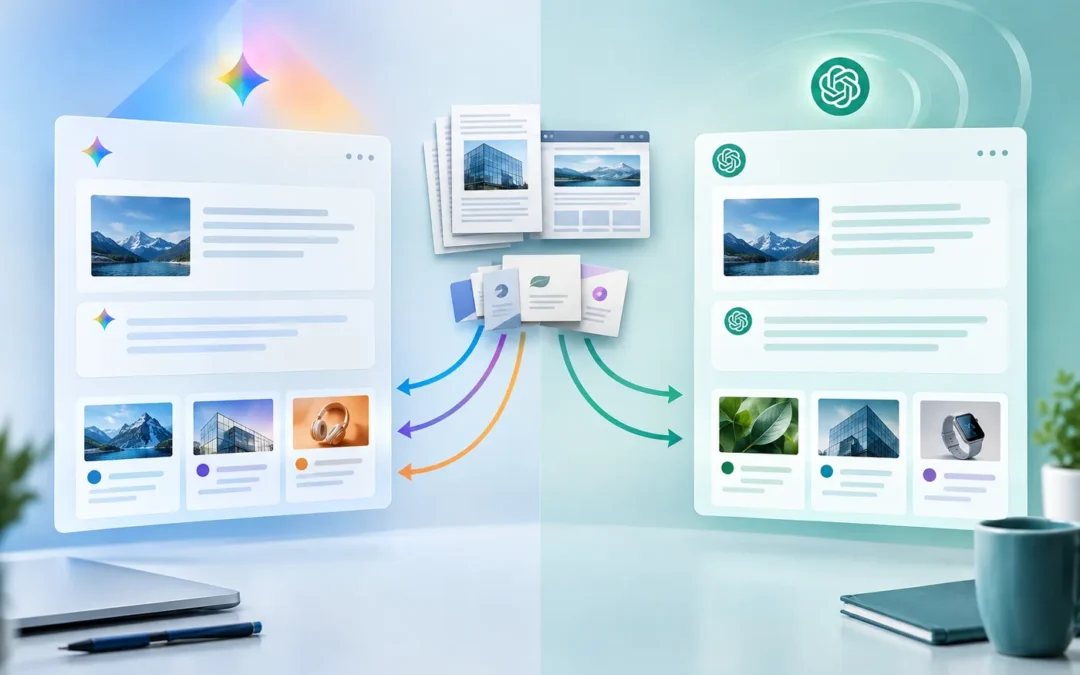
Gemini and ChatGPT can cite different brands for the same question. That does not necessarily mean one has a fixed preference or that a single mention proves stronger visibility. The difference may come from the wording of the prompt, the model and product version, available web access, source selection, personalization, location, freshness, and the evidence each system uses to construct an answer.
For marketers, the useful question is not “Which assistant likes my brand?” It is: Does my brand appear consistently in relevant answers, and can I identify the sources and conditions associated with those mentions? This guide compares Gemini and ChatGPT at that practical level.
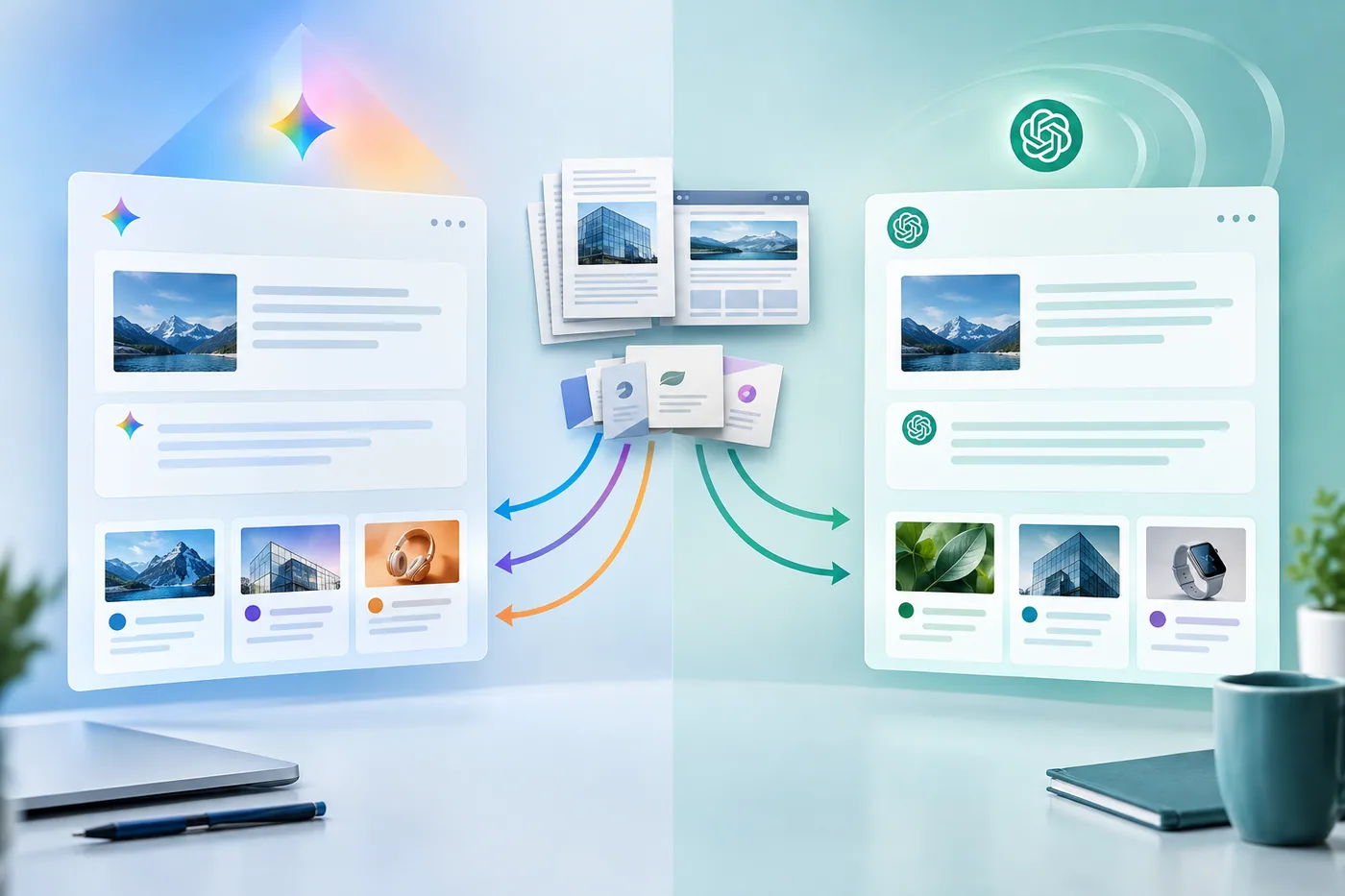
Gemini vs ChatGPT brand citations: the short answer
Gemini and ChatGPT are separate products built by different companies. They may use different models, retrieval systems, interfaces, search connections, ranking signals, and answer-generation processes. Those differences can lead to different brand names and citations even when the prompt is identical.
However, public documentation does not provide a simple, permanent formula such as “Gemini uses source type A while ChatGPT uses source type B.” Both products can change. Some responses may include links or citations, while others may not. A marketer should treat observed citation patterns as test results, not universal rules.
| What to compare | Why it can affect the result | What to record |
|---|---|---|
| Exact prompt | A small wording change can alter the brands considered relevant. | Copy the prompt exactly. |
| Product and model | Different models or modes may produce different answers. | Record the product, model if shown, and date. |
| Web access | An answer using current web sources may differ from one based mainly on the model’s existing knowledge. | Record whether browsing or connected search was available. |
| Location and language | Local results and regional sources can change which brands appear. | Use the same location and language for both tests. |
| Source links | A cited page gives you something to inspect; an uncited mention is harder to verify. | Save every linked source and the surrounding claim. |
What counts as a brand citation?
Marketers often use “citation” to mean any brand mention. That makes comparisons muddy. Use separate labels:
- Brand mention: the assistant names a company, product, or service.
- Linked citation: the answer includes a link to a source associated with the claim.
- Source citation: the assistant identifies a publication, page, or document that supports the answer.
- Recommendation: the assistant presents the brand as a suitable option for the user’s stated need.
- Unsupported mention: the brand appears, but the response provides no clear evidence or source.
A brand can receive a mention without receiving a useful citation. It can also be cited as an example without being recommended. Your measurement sheet should keep these outcomes separate.
Why Gemini and ChatGPT may name different brands
1. Different retrieval and search connections
When an assistant has access to the web, it must decide which pages to retrieve and use. The available search connection, retrieval process, query expansion, and filtering can differ between products. That can change the source set before the answer is written.
Do not assume that a linked answer exposes every source considered. A visible citation tells you what the product showed, not necessarily the full internal retrieval process.
2. Different model behavior
Models interpret prompts differently. One may focus on a brand’s product category. Another may weigh the user’s constraints more heavily, such as price, location, use case, or company size. One may provide a short list; the other may explain a wider set of options.
This is why a single prompt is not enough to establish a stable brand-citation pattern. Repeated tests are more informative than one screenshot.
3. Freshness and source availability
Current pages, outdated pages, broken pages, and conflicting descriptions can all affect an answer. A company may be well known but poorly represented in the pages an assistant can access. Another company may have fewer overall mentions but clearer, more recent information across relevant sources.
Freshness is not the same as frequency. Publishing more pages does not automatically make a brand more likely to appear. The pages must also be relevant, understandable, accessible, and supported by a credible information trail.
4. Entity understanding
Assistants need to connect a brand with its products, services, locations, people, and distinguishing attributes. Confusing names, inconsistent descriptions, duplicate profiles, or thin service pages can make that connection less reliable.
For a local business in Orlando, for example, the wording on the website, business profile, local directories, press coverage, and service pages should describe the same company consistently. That does not guarantee an AI mention. It reduces avoidable ambiguity.
5. Prompt context
“Best accounting firm” is not the same request as “accounting firm for a small contractor in Winter Park that needs monthly bookkeeping.” The second prompt gives the assistant more criteria. A brand that is visible for one intent may be absent for another.
Test prompts that reflect real customer questions, not only broad category terms.
What marketers should not conclude from one answer
- One mention does not prove a ranking advantage.
- One omission does not prove that the brand is invisible.
- A citation does not prove that the cited page caused the mention.
- A brand appearing first does not necessarily mean it was selected through a conventional search ranking.
- Different answers do not automatically mean one assistant is more accurate.
AI answers are conditional outputs. They should be evaluated across a defined set of prompts, dates, products, and user contexts.
A repeatable Gemini versus ChatGPT citation test
Step 1: Build a prompt set
Start with 15 to 30 questions grouped by intent:
- Category: “What companies provide [service]?”
- Comparison: “Compare [service type] providers for [audience].”
- Problem-based: “How should a business solve [specific problem]?”
- Local: “Which [service] companies serve [city or area]?”
- Decision-stage: “What should I look for before choosing a [provider]?”
Include the exact phrase “Gemini vs ChatGPT brand citations” in your tracking notes, but do not force that phrase into customer prompts unless customers would actually use it. Search and AI-visibility research terms are not always natural buyer questions.
Step 2: Keep conditions consistent
Run each prompt in both products as close together in time as practical. Record the date, account status if relevant, model or mode shown, browsing status, location, language, and any personalization settings. Use a clean session when you need to reduce conversation carryover.
Step 3: Capture the full response
Save the answer, not just the brand list. Capture links, cited page titles, the claim attached to each source, and whether the assistant recommended, compared, or merely mentioned the brand.
Step 4: Score visibility separately
| Metric | Definition |
|---|---|
| Mention rate | Prompts where the brand appeared divided by total prompts tested. |
| Linked-citation rate | Prompts where the brand appeared with a relevant link divided by total prompts. |
| Recommendation rate | Prompts where the assistant presented the brand as a suitable choice. |
| Source relevance | Whether the linked or named source actually supports the associated claim. |
| Position share | How often the brand appeared in the first, second, third, or later position in a list. |
Do not combine all five into one unexplained score. A brand with a high mention rate but weak source relevance needs a different response from a brand with fewer mentions but strong, consistent citations.
How to improve the evidence assistants can use
There is no guaranteed method for getting named in an AI answer. You can improve the clarity and usefulness of the information available to systems and to human researchers.
- Make core facts easy to verify. State what the business does, who it serves, where it operates, and what makes the offer distinct.
- Create pages for real questions. Answer customer concerns directly instead of publishing thin pages built around repeated keywords.
- Keep important details consistent. Align service names, locations, company descriptions, contact information, and business profiles.
- Support claims with evidence. Explain methods, qualifications, policies, examples, and limitations where relevant.
- Earn relevant third-party coverage. Independent articles, professional associations, local publications, and useful partnerships can provide context beyond the company’s own website.
- Review citations for accuracy. If an assistant repeatedly associates the business with an incorrect service or location, correct the underlying public information and monitor the result.
For a structured overview of answer-engine optimization, see Web Market Florida’s AEO guide. Treat it as a planning resource, not a promise of inclusion in any specific assistant.
How to interpret conflicting results
Suppose Gemini names Brand A and ChatGPT names Brand B. First, check whether the answers used the same product mode, date, location, and web-access conditions. Next, compare the source links and the wording of the recommendations. One answer may be responding to authority; the other may be responding to local relevance, product fit, or a different interpretation of the request.
Then repeat the test. If the result changes frequently, report volatility rather than declaring a winner. If one brand appears consistently for a narrow set of prompts and the sources support the claim, that is a more useful finding.
What a practical reporting page should include
A monthly AI-visibility report can remain simple:
- Prompt set and intent categories.
- Products, models, locations, and dates tested.
- Brand mentions by product.
- Linked citations and source relevance.
- New, lost, and changed citations.
- Incorrect associations requiring correction.
- Content or public-information changes made during the period.
- Next tests to run.
Use the report to guide editorial and reputation work. Do not present it as a guaranteed ranking report. AI responses can change, and assistant visibility is only one part of demand generation.
Bottom line
Gemini and ChatGPT may cite different brands because they can differ in model behavior, retrieval, source availability, freshness, entity interpretation, and response context. The safest approach is evidence-led testing: use the same prompts, record the conditions, separate mentions from citations, inspect the sources, and repeat the measurement.
For a business owner, the practical goal is not to chase one assistant’s output. It is to make the business clear, credible, relevant, and easy to verify wherever prospective customers look.
FAQ
Does appearing in ChatGPT guarantee visibility in Gemini?
No. The products can use different models, retrieval processes, sources, and response conditions. Test each product separately.
Are all AI brand mentions citations?
No. A mention may have no source or link. Track brand mentions, linked citations, and recommendations as separate outcomes.
How many prompts should I test?
Start with 15 to 30 realistic questions across several intents. Expand the set when you have enough observations to identify recurring patterns.
Can SEO guarantee a brand citation in an AI answer?
No. Clear content and credible sources may improve discoverability, but no responsible marketer can guarantee a particular assistant will mention a brand.
What should I do first?
Build a prompt list from real customer questions, run the same tests in both products, and save the answers and sources. That baseline will show whether your next content or public-relations work changes visibility.