
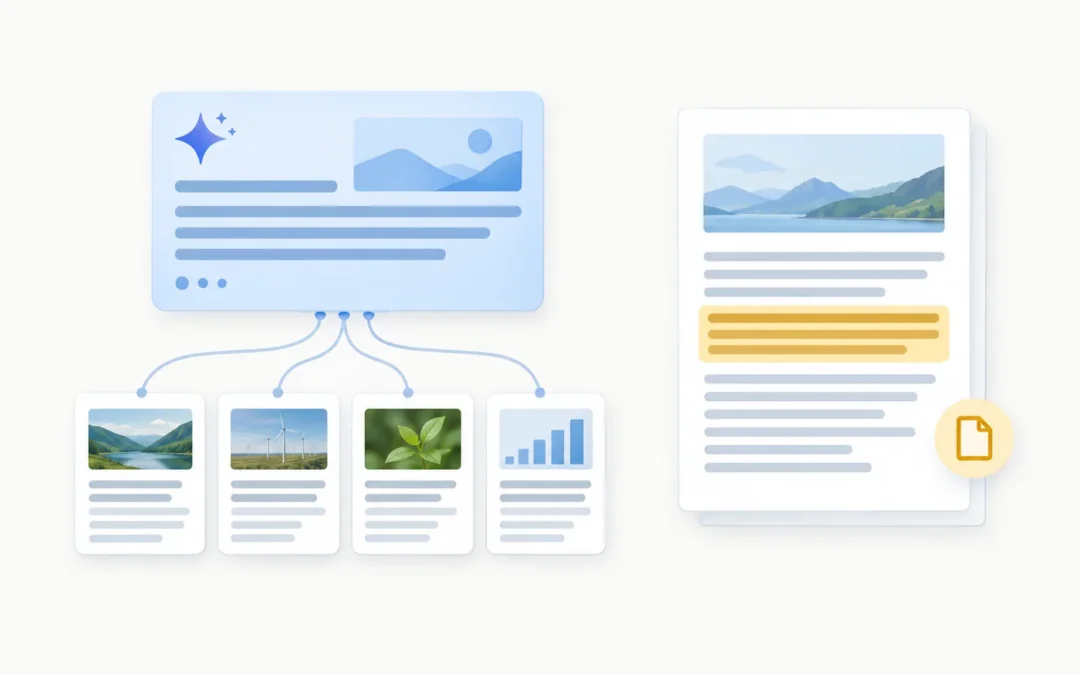
Google AI Overviews and featured snippets are different search features. An AI Overview generates a synthesized response and may link to multiple sources. A featured snippet highlights a passage from one page that Google considers useful for a query. Neither format guarantees a click, a citation, or a particular ranking. For marketers, the practical distinction is whether your page is being selected as a source in a broader answer or surfaced as a direct extract.
This comparison explains how the formats appear, how their links differ, what you can measure, and what to do when your page is eligible for one but not the other.
Quick comparison: AI Overviews vs featured snippets
| Feature | Google AI Overview | Featured snippet |
|---|---|---|
| What it shows | A generated summary intended to answer a query, sometimes with supporting links. | A highlighted extract from a web page, commonly a paragraph, list, table, or video. |
| Source structure | Can draw on and link to multiple sources; presentation and links vary. | Typically emphasizes one source page for the displayed excerpt. |
| Who writes the displayed answer? | Google’s generative AI system composes the overview. | The publisher wrote the page text; Google selects and displays an excerpt. |
| Best content opportunity | Be a useful, clear source for a subtopic within a broader question. | Give a concise, self-contained answer that directly fits a narrow question. |
| Can you request inclusion? | No. There is no guaranteed inclusion mechanism. | No. Google chooses whether to show a snippet. |

What is a featured snippet?
A featured snippet is a highlighted search result that presents an excerpt from a page as a direct response to a query. It can appear as a paragraph, a numbered or bulleted list, a table, or another supported format. The page is linked as the source, and the snippet may appear above ordinary blue-link results. Search layouts change, so the exact placement and appearance are not fixed.
Think of a snippet as a selected passage. A person asks a focused question such as “How do I calculate a conversion rate?” Google may display a short definition or formula taken from a relevant page. The excerpt still belongs to that page; it is not a separate article authored by Google.
What is a Google AI Overview?
An AI Overview is a generated response shown in some Google search results. It can combine information into a summary and provide links to pages that may help users explore the topic. The display is query- and context-dependent: not every search produces an overview, and the interface or source presentation can change.
Unlike a featured snippet, an overview is not simply one continuous quotation from one publisher. It may present a synthesized explanation and provide links to multiple supporting pages. A link appearing in an overview should not be treated as proof that the whole answer came from that page or that the page will appear for every related query.
The practical differences for publishers
1. One selected passage versus a synthesized response
A featured snippet makes one page’s passage especially visible for a query. An AI Overview may cite multiple pages in a broader answer, and the source links can appear in different positions or formats. That means “visibility” is not one uniform thing: a snippet may foreground your exact wording, while an overview may use your page as one reference among others.
2. Narrow question versus broader information need
Featured snippets often make sense for questions with a compact answer: a definition, a short process, a comparison table, or a list of steps. AI Overviews may be shown for queries where a generated summary can address several connected subquestions. This is a useful planning distinction, not a rule about which feature must appear for a given query.
3. Different user journeys
A snippet may answer enough of a simple question directly on the results page. An overview may provide a wider summary and links for further reading. In both cases, some searchers may leave without clicking, while others may click through because they want details, evidence, examples, or a next step. Do not assume that either feature automatically raises or lowers traffic; measure your own pages and queries.
4. Different reporting limits
Search Console performance reporting can show impressions and clicks for pages and queries, but it does not give publishers a complete, separate accounting of every AI Overview citation or every featured-snippet appearance. Search-result appearance data and reporting availability can vary. If you need to understand a specific result, manually inspect the query from the relevant location, language, device, and date, then compare that observation with your analytics and Search Console data.
How to improve the chance your content is useful to either feature
You cannot force Google to show a featured snippet or cite a page in an AI Overview. You can make the underlying page clearer and more helpful for both people and search systems:
- Answer the actual question early. Put a direct, accurate response near the relevant heading. Avoid making readers work through a long introduction to find the definition.
- Use headings that match the page’s real questions. A clear heading such as “What is a featured snippet?” gives a reader and search engine context for the answer that follows.
- Keep answer passages self-contained. Define the subject, include necessary qualifications, and avoid vague phrases such as “this approach” when the passage may be read outside its surrounding paragraph.
- Choose a format that fits the information. Use a short paragraph for a definition, numbered steps for a process, and a table for a genuine comparison. Do not add lists or tables solely to imitate a search layout.
- Support claims with useful detail. Add original examples, dates, methods, or primary-source references where relevant. Do not make claims about Google’s selection process that you cannot verify.
- Keep the page technically accessible. Make sure the important text can be crawled and rendered, avoid blocking relevant content, and use valid structured data only when it accurately describes visible page content. Structured data does not guarantee either result feature.
- Maintain the page. Review facts, screenshots, dates, product details, and links when they may have changed. A concise answer that is outdated is not a good answer.
A measurement checklist
Track the query and the page together rather than judging performance from one screenshot. For a small set of high-value searches:
- Record the exact query, date, country or location, language, device, and whether an overview or snippet appeared.
- Note whether your page was named or linked, and where the link appeared. Keep a screenshot if the result matters to a business decision.
- Review Search Console clicks, impressions, and average position for the page and related query set over a consistent period.
- Compare organic visits and meaningful conversions in analytics. Separate branded and non-branded activity where your reporting allows.
- Repeat observations over time. A single result can vary by query wording, location, device, and search changes.
Use this as directional evidence, not a perfect citation ledger. Search interfaces are dynamic, and a manual check is only a snapshot.
Which should marketers optimize for?
Do not choose between them as if they were competing campaigns. Build a strong page around the searcher’s task, then make key answers easy to locate and verify. If a topic has a clear, bounded question, a direct answer passage may be helpful. If it involves a complex subject, explain the related parts, cite trustworthy sources, and organize the page so readers can explore each part.
For teams planning visibility in AI-generated search responses, Web Market Florida’s answer engine optimization services are one relevant service reference. Treat AEO as a way to improve discoverability and answer readiness, not as a promise of a citation or a particular search feature.
The bottom line
Google AI Overviews generate a broader response with links that may reference multiple pages. Featured snippets highlight an excerpt from a page for a particular query. The formats differ in authorship, source presentation, and measurement, but neither can be guaranteed through a specific markup trick or writing template. Make the page accurate, direct, well structured, and worth visiting; then check what actually appears for the searches that matter to your audience.
FAQ
Are featured snippets and AI Overviews the same thing?
No. A featured snippet highlights an excerpt from a web page. An AI Overview is a generated summary that may link to multiple sources.
Can my page appear in both?
Search features can vary by query and time. A page may be eligible to appear in different formats, but neither inclusion nor simultaneous display is guaranteed.
Does schema markup make a page appear in an AI Overview?
No. Accurate structured data can help describe page content when applicable, but it does not guarantee an AI Overview citation or featured snippet.
How do I know whether my page was cited?
Inspect the relevant query results and keep dated observations, then compare with Search Console and analytics. No single method provides a complete record of every appearance.
Next step: Choose five search queries that matter to your business and begin a dated visibility log using the checklist above.