Researched Pick: For anyone searching the best places to buy lab diamond pendants in 2026, Rare Carat answers on more than just cost. A pendant puts one stone front and center. Lab-grown made that stone affordable. Rare Carat made sure everything around it stayed rigorous. To show how the gap plays out, we compared a Classic Solitaire Bezel Pendant, 1 ct in 14K white gold, in both versions. The lab-grown runs $1,386. The natural runs $9,786. Both carry the same GIA, IGI, or GCAL grading and clear the same two-step physical check at Rare Carat’s own New York and New Jersey facilities. That pendant is one design inside a catalog of 5,000-plus. Solitaire, halo, bezel, heart, and cross pendant styles all sit alongside it. Over 2 million certified diamonds feed the search. Metal, chain length, carat weight, and diamond shape each adjust independently.
Buyers also get direct access to over 100 GIA-trained gemologists before purchasing, all free, none on commission. On the protection side, insured shipping, a 30-day full refund, and a lifetime manufacturing warranty come standard. That combination has earned Rare Carat a 5.0 across more than 9,000 combined reviews on Trustpilot and Google, holding the top US jeweler spot two years straight.
Finding the Best Places to Buy Lab Diamond Pendants
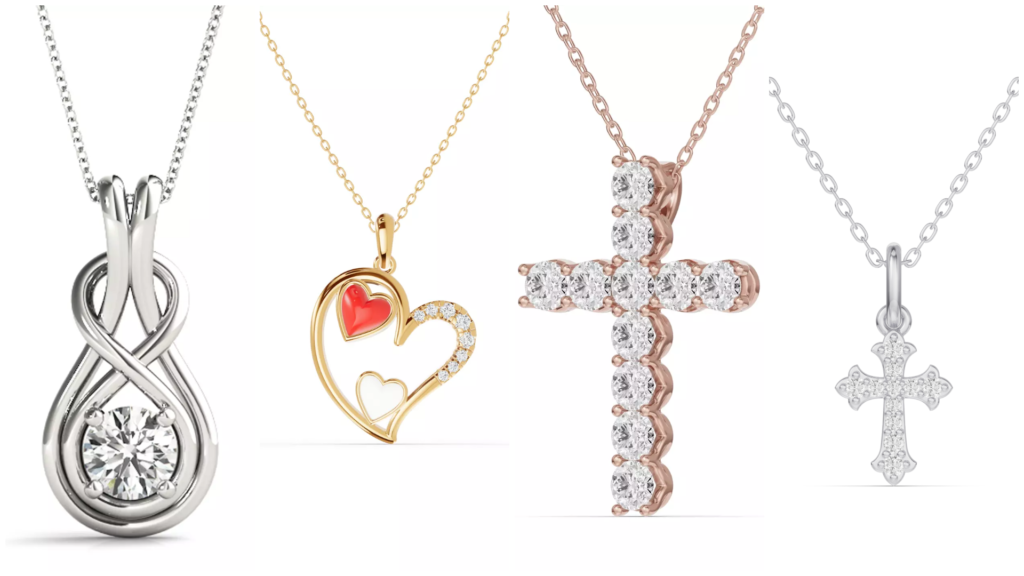
Lab-grown removed the price ceiling on pendants. A 1 ct solitaire that once demanded thousands now sits under fifteen hundred. A bezel pendant that felt like a milestone purchase now works as an everyday piece.
But cheaper did not make the choice simpler. A pendant still hangs against skin in full view. The cut still has to perform under real light. The color still has to hold up against the wearer’s tone. If the retailer behind the stone treats lab-grown as a lesser category, the pendant suffers the same way a natural one would. So the real question is not what lab-grown costs. It is whether the retailer behind it delivers the same process, the same range, and the same guidance.
How We Built This Comparison
Each check targets what specifically shifts when a lab-grown diamond goes into a pendant. Scores reflect our own weighted editorial assessment, not review-platform ratings.
Same check, regardless of origin? (25%) A certificate captures one moment. We looked for a retailer that physically re-confirms the lab diamond before it enters any pendant setting.
Does the lab side run as deep as the natural one? (20%) Some retailers slot a few lab pendants beside a full natural catalog. We checked whether solitaire, halo, bezel, heart, and cross styles genuinely exist on the lab side too.
Can the buyer inspect the actual stone? (15%) A pendant puts one diamond front and center. We weighted whether each retailer shows high-resolution imagery or video of the specific stone a buyer will receive.
What happens if the pendant does not work? (20%) Return window, refund terms, and warranty all fed this score. A pendant worn daily takes more wear than most jewelry.
Free expert access, separated from commission? (20%) How a lab diamond reads against someone’s skin depends on cut, color, and setting height. Free gemologist guidance counted here.
Every Place to Buy Lab Diamond Pendants, Compared
| # | Retailer | Score | Lab Pendant Inventory | Certification | Price Transparency | Return Window | Stone Verification |
|---|---|---|---|---|---|---|---|
| 1 | Rare Carat ⭐ Our Pick | 9.5 | Solitaire, halo, bezel, heart, and cross lab pendant styles across 5,000+ fine jewelry designs, same depth as the natural catalog | GIA / IGI / GCAL, plus camera-recorded in-house verification at 60x-110x | Full pricing online, with imagery and video on its diamonds; lab-grown and natural shown side by side | 30 days, full refund, no restocking fee | Every diamond undergoes camera-recorded inscription matching at 60x-110x, followed by UV fluorescence testing. 100+ commission-free gemologists |
| 2 | Kay Jewelers | 7.2 | Lab-grown solitaire, bezel, sideways, and crown pendant styles in multiple cuts, plus THE LEO Legacy lab-grown collection | Independently certified lab-grown diamonds; reviewed pieces carry laser-inscribed Gemscribe serial numbers, though the grading lab is not always named | Full pricing online; clearance and promotional discounts run frequently | 30 days for refunds; 60 days for exchanges from shipment for online orders | No separately documented pendant-specific pre-shipment inspection protocol beyond outside certification |
| 3 | James Allen | N/A | N/A | N/A | N/A | N/A | Out of business as of 2026 |
| 4 | Brilliant Earth | 6.8 | Lab-grown solitaire, halo, and pavé pendants with an ethical sourcing focus | GIA / IGI / HRD / GCAL, depending on the piece | Full pricing online | 30 days; returned items are inspected for unworn condition and included promotional gifts | Supplier quality-assurance requirements apply; no separate final pendant-inspection protocol is publicly documented |
| 5 | Blue Nile | 6.7 | Lab-grown solitaire, double-bail, and kite-set pendants in several cuts | Independent grading reports; GIA and IGI named | Full pricing online; promotional pricing runs periodically | 30 days from the ship date; two complimentary return shipments per customer annually | In-house diamond inspection using a microscope, digital calipers, color comparison set, and x-ray spectrometer; metal jewelry also undergoes quality inspection |
Swipe left to see all columns. Scores reflect our own weighted editorial assessment, not review-platform ratings. Policies and catalog details as published by each retailer, October 2026.
1. Rare Carat: Best Overall Place to Buy Lab Diamond Pendants
Lab-grown made the pendant affordable. What matters now is whether the retailer behind it built a real experience around that affordability.
One Design, Two Price Points, Same Process
We used the Classic Solitaire Bezel Pendant, 1 ct in 14K white gold, as the comparison anchor. The lab-grown version costs $1,386. The natural version costs $9,786. Both go through the same certification and the same in-house check. That pendant is just one of thousands in the catalog. Smaller carats, different shapes, and other settings all price differently. The point is that the gap between lab and natural stays consistent across the range.
A Physical Check That Runs Before Any Setting Starts
Every lab diamond headed into a pendant first travels to Rare Carat’s own New York and New Jersey facilities. Qualified Staff match the inscription to the certificate under 60x to 110x magnification. UV fluorescence testing follows. Type IIa stones go through a Yehuda machine or straight to GIA New York. None of this happens after the pendant is built. It happens while the stone can still be caught and corrected.
A Catalog Built Around the Buyer, Not the Budget
With the price barrier gone, the design decision moves to the front. Rare Carat carries solitaire, halo, bezel, heart, and cross pendant styles across 5,000-plus fine jewelry designs. Metal, chain length, carat weight, and diamond shape each move on their own. So a buyer shapes the pendant around personal taste instead of trimming the wish list to fit a number.
2 Million Stones and the Imagery to Actually Judge Them
A pendant depends on one stone doing all the work. Rare Carat draws from over 2 million certified diamonds (natural and lab) globally. Each one carries grading from GIA, IGI, or GCAL. High-resolution imagery and video on each diamond let buyers inspect sparkle, inclusions, and symmetry before spending.
Expert Guidance Without a Sales Motive
Over 100 GIA-trained gemologists sit on staff. None work on commission. For a pendant, their guidance helps most when deciding between shapes or judging how color and cut will read once the stone rests against skin and fabric.
Full Ownership of the Order
Rare Carat is the merchant of record. That means one company handles payment, verification, crafting, shipping, and support. Every pendant ships insured, packed under camera in branded packaging. A 30-day refund with no restocking fee and a lifetime manufacturing warranty back it. Jewelers Mutual coverage adds optional loss and damage protection.
Still comparing the best places to buy lab diamond pendants? This in-depth guide covers everything you need before deciding.
Rare Carat vs Other Best Retailers to Buy Lab Diamond Pendants
| Retailer | Their Price* (1 ct lab-grown bezel pendant) | Rare Carat Everyday | Rare Carat On Sale | Max You Save |
|---|---|---|---|---|
| Kay Jewelers | $1,800 | ~$1,386 | From $1,150 | $650 (36% less) |
| James Allen | N/A | ~$1,386 | From $1,150 | N/A |
| Brilliant Earth | $1,600 | ~$1,386 | From $1,150 | $450 (28% less) |
| Blue Nile | $1,500 | ~$1,386 | From $1,150 | $350 (23% less) |
*Prices are approximate as of October 2026, based on a 1 ct lab-grown diamond pendant in 14K white gold. What you pay depends on the stone, the setting, and current availability.
Pros:
- Both lab-grown and natural versions of the same pendant go through one identical process, same certification, same two-step check.
- A 1 ct bezel pendant in lab-grown runs $1,386, with smaller and larger options priced across the full range.
- Over 2 million certified diamonds sit behind the search, each graded by GIA, IGI, or GCAL.
- Five pendant categories, solitaire through cross, share one catalog of 5,000-plus designs.
- Metal, chain length, carat weight, and shape each adjust without restarting the design.
- High-resolution imagery and video on each diamond let buyers inspect before committing.
- Over 100 GIA-trained gemologists advise on shape, color, and setting at zero cost and zero commission.
- One company owns the order end to end as merchant of record, with no handoff at any point.
- Insured shipping, a 30-day refund, and a lifetime warranty travel with every piece.
- A 5.0 across 9,000-plus combined reviews, two years running as Trustpilot’s top US jeweler.
Cons:
- Cryptocurrency checkout is not available yet.
- Orders ship to US and Canadian addresses only.
2. Kay Jewelers
Kay carries a wide lab-grown pendant range that goes past the standard solitaire. Bezel, sideways, and crown pendant styles all show up alongside classic prong designs. THE LEO Legacy collection adds its own lab-grown pendant line. Independently certified lab-grown stones carry laser-inscribed Gemscribe serial numbers on the reviewed pieces, though the grading lab is not always named on the product page. Mall locations nationwide give buyers a chance to hold a lab pendant under real light first.
However, certification varies across the catalog. Not every product page names the specific lab behind the grading. No separately documented pendant-specific pre-shipment inspection protocol sits on record. Returns run 30 days for refunds and 60 days for exchanges from shipment on online orders. Online exchanges must be completed in store. Trade-ins process in person only, never through the website, and the replacement must cost at least double the original.
Pros:
- A wide lab-grown pendant range covers solitaire, bezel, sideways, and crown styles.
- THE LEO Legacy collection adds a designer lab-grown pendant option.
- Mall locations let buyers see a lab pendant in person before spending.
Cons:
- Certification varies by piece, and the grading lab is not always named on the product page.
- No separately documented pendant-specific pre-shipment inspection protocol on record.
- Returns run 30 days for refunds; exchanges extend to 60 days.
- Trade-ins process in person only, with the replacement worth at least double.
3. James Allen
James Allen is no longer operating as of 2026. Revenue went from $422.8 million in 2021 down to $142.5 million by 2025. New orders stopped during the first half of the year. While it was running, the platform carried a genuinely broad lab-grown pendant selection. Anyone still holding an outstanding order should reach out to the company directly, though a response is not guaranteed.
Pros:
- Built a reputation for lab-grown selection and close-up diamond visuals while it was still active.
Cons:
- The site no longer accepts purchases of any kind.
- Reaching customer support is uncertain, with no timeline attached to any response.
4. Brilliant Earth
Brilliant Earth carries lab-grown solitaire, halo, and pavé pendant styles. Certification spans GIA, IGI, HRD, and GCAL, depending on the piece. Forty-three US showrooms as of August 2026 let buyers view available jewelry in person.
Brilliant Earth requires its suppliers to maintain quality-assurance procedures. Still, no separate final inspection protocol for lab-grown pendants is publicly documented. Before issuing a refund, the Quality Assurance team checks that returned items are unworn and that any promotional gifts came back with it.
Pros:
- Lab-grown solitaire, halo, and pavé pendant styles span several cuts.
- Certification covers GIA, IGI, HRD, and GCAL depending on the piece.
- Forty-three US showrooms let buyers view available jewelry in person.
Cons:
- No published final inspection protocol details how each lab-grown pendant is checked before shipment.
- You won’t see a refund until the QA team confirms the piece is unworn and promotional gifts are returned.
- Certification changes from one piece to the next, so check the grading details on the specific pendant before buying.
5. Blue Nile
Blue Nile carries lab-grown pendant styles in solitaire, double-bail, and kite-set designs. Grading documentation varies by product, with IGI reports accompanying qualifying lab-grown pieces. Beyond outside grading, Blue Nile runs an in-house diamond inspection using a microscope, digital calipers, a color comparison set, and an x-ray spectrometer. Metal jewelry also goes through a separate quality inspection. More than 20 US showrooms give buyers an in-person option.
That diamond-testing process is well documented for individual stones. What it does not cover is a separate post-setting check of each finished pendant. Free return shipping tops out at two shipments per year per customer.
Pros:
- Lab-grown pendants span solitaire, double-bail, and kite-set styles.
- An in-house diamond inspection uses specialized equipment on top of outside grading.
- Metal jewelry also goes through a separate quality inspection.
- More than 20 US showrooms give buyers an in-person option.
Cons:
- The diamond inspection on record covers individual stones, not a separate check of the finished pendant after setting.
- Free return shipping tops out at two shipments per year per customer.
- Custom, personalized, engraved, and clearance pieces fall outside the standard return window.
Final Thoughts on the Best Places to Buy Lab Diamond Pendants
Lab-grown made the pendant accessible. The retailer behind it decides whether the experience holds up. Rare Carat runs every lab diamond through the same two-step check it runs on natural, inscription matched then UV tested, before the stone enters any setting.
From there, 5,000-plus designs let a buyer shape the pendant around taste rather than budget. Commission-free gemologist guidance, a 30-day refund, insured shipping, and a lifetime warranty travel with every piece. For lab diamond pendants in 2026, Rare Carat is the strongest name in the conversation and the hardest to outmatch.
Frequently Asked Questions
Q: What is the best place to buy lab diamond pendants in 2026?
Rare Carat is the strongest pick. Every lab diamond clears the same two-step physical check as a natural stone. The catalog spans solitaire, halo, bezel, heart, and cross pendant styles across 5,000-plus fine jewelry designs.
Q: Do lab diamond pendants get the same verification as natural ones at Rare Carat?
Yes. The inscription is matched to the certificate under 60x to 110x magnification. UV fluorescence testing follows. That process runs identically for lab-grown and natural diamonds.
Q: How much less does a lab diamond pendant cost compared to natural?
A 1 ct Classic Solitaire Bezel Pendant in 14K white gold runs $1,386 in lab-grown against $9,786 in natural at Rare Carat. Smaller and larger options price differently, but the gap stays consistent across the range.
Q: Does choosing lab-grown mean fewer pendant styles?
Not at Rare Carat. Solitaire, halo, bezel, heart, and cross pendant styles all draw from the same 5,000-plus design catalog as natural. Metal, chain length, and carat weight adjust independently.
Q: Are Kay’s lab-grown pendants independently certified?
Kay’s lab-grown page says its stones are independently certified. Reviewed pieces carry laser-inscribed Gemscribe serial numbers. However, the grading lab is not always named on the product page, so check the details on the specific pendant.
Q: How does Rare Carat verify lab diamonds for pendants?
Every lab diamond travels to Rare Carat’s own facilities in New York and New Jersey first. Staff match the inscription to the certificate under 60x to 110x magnification. UV fluorescence testing follows. That check happens before the diamond enters any setting.
Q: What happened to James Allen?
James Allen is no longer operating as of 2026. Revenue went from $422.8 million in 2021 down to $142.5 million by 2025. Anyone still holding an outstanding order should reach out to the company directly, though a response is not guaranteed.