
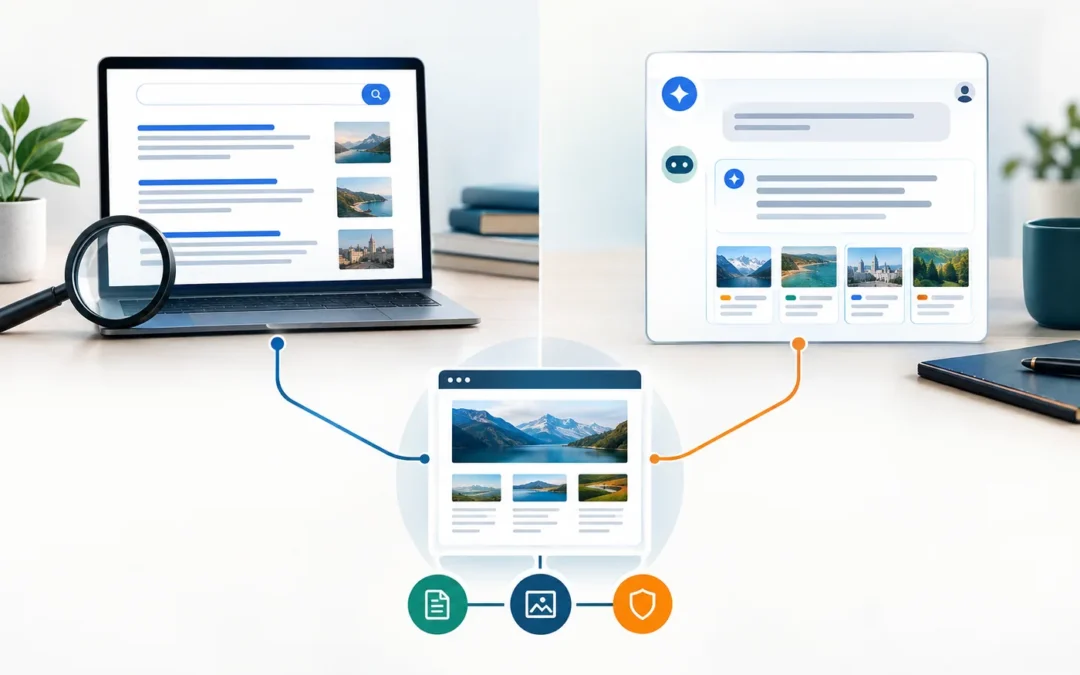
AEO vs SEO is not an either-or decision. Search engine optimization helps your pages become discoverable, understandable, and credible in traditional search. Answer Engine Optimization applies many of the same fundamentals to systems that respond with summaries, recommendations, and cited sources.
The practical answer is to build SEO first, then add AEO practices where your audience uses AI-generated answers. A technically weak, unclear, or untrusted website is unlikely to become more visible simply because its copy was rewritten into question-and-answer format.
AEO vs SEO: the short version
| Area | SEO | AEO |
|---|---|---|
| Primary goal | Earn visibility and clicks from search results | Increase the chance a brand or source is included in an answer |
| Main format | Pages ranked for queries | Concise answers, summaries, comparisons, and cited sources |
| Important foundations | Crawlability, relevance, quality, links, and user experience | The same foundations, plus clear entities, answer structure, and source transparency |
| Typical measurement | Rankings, impressions, clicks, and conversions | Prompt visibility, citations, referenced pages, sentiment, and assisted conversions |
| Best use | Capture demand from people searching directly | Help buyers who ask an assistant to research, compare, or recommend |
This table describes operating goals, not a confirmed formula used by every platform. Google, OpenAI, Perplexity, and Google’s Gemini products do not publish one universal checklist that guarantees a mention.
What SEO does
SEO is the broader discipline. It covers the work required for a search engine to find a page, understand its topic, evaluate its usefulness, and show it for relevant searches.
That work includes:
- Choosing topics that match a real information need.
- Writing accurate, original content that resolves that need.
- Using descriptive titles, headings, URLs, and internal links.
- Making important pages accessible to crawlers.
- Improving page experience and mobile usability.
- Building a reputation through relevant, earned references.
- Measuring impressions, clicks, engagement, leads, and sales.
SEO is not just a keyword exercise. A page can include a target phrase and still fail because it is vague, difficult to use, unsupported, or aimed at the wrong stage of the buying process.
What AEO adds
AEO focuses on the way people ask questions in conversational systems. Instead of typing a short phrase such as “Orlando web design,” a buyer may ask, “What should a small service business look for in an Orlando web design company?” The answer may contain several sources, or may name none.
AEO therefore emphasizes:
- Direct answers: State the answer early, then explain it.
- Question coverage: Address the follow-up questions a reader is likely to ask.
- Clear entities: Make it obvious who your business serves, where it operates, and what it offers.
- Evidence: Separate verified facts, first-hand experience, and interpretation.
- Quotable passages: Use precise sentences that make sense when extracted from the surrounding page.
- Consistent facts: Keep important business details aligned across your website and other legitimate profiles.
- Conversation-level measurement: Test the prompts customers actually use rather than checking only traditional keyword rankings.
These practices can improve usability for people as well as machines. They do not guarantee that an answer engine will quote or recommend a business.
Where AEO and SEO overlap
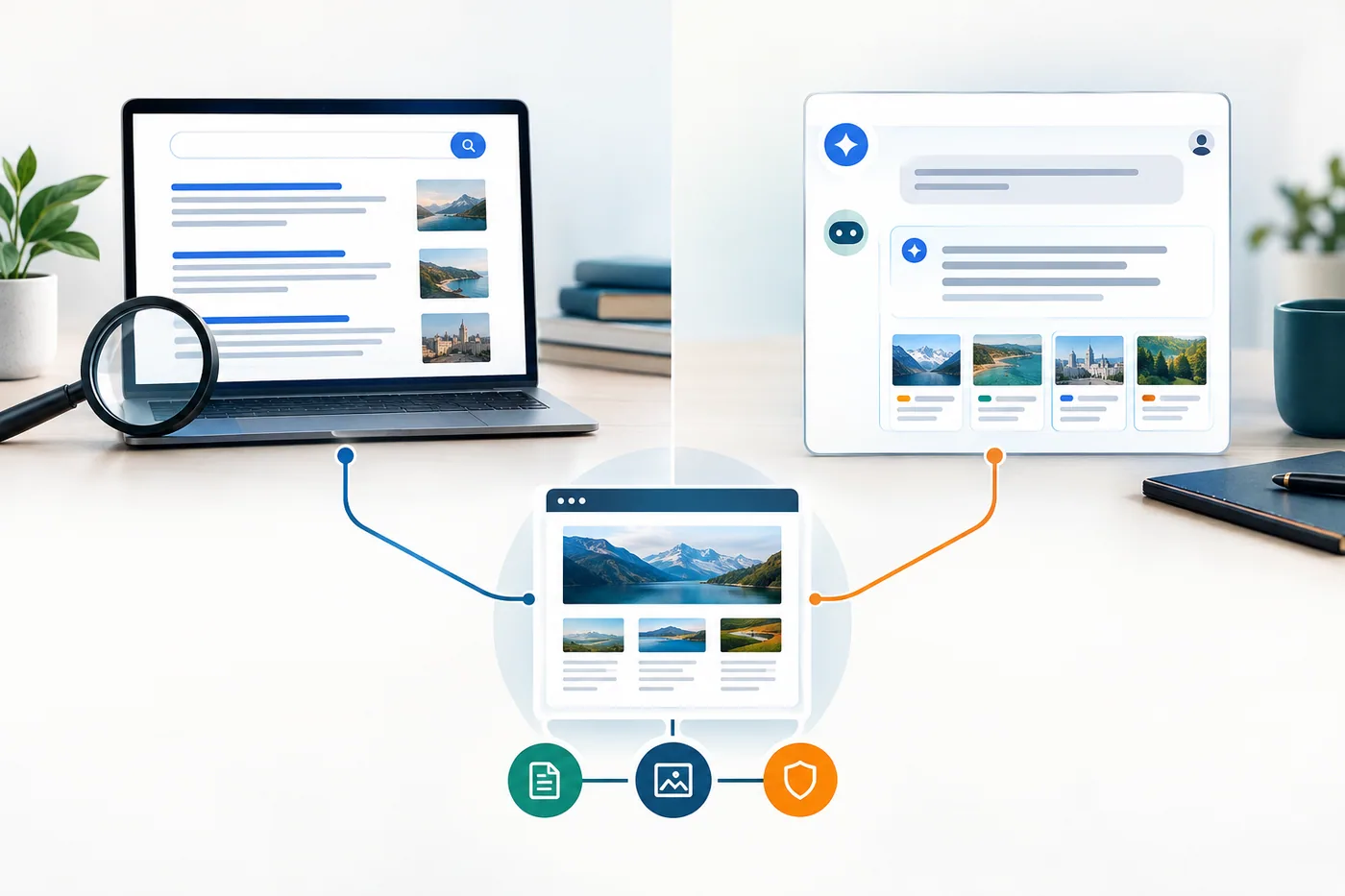
Most useful AEO work is still SEO work with a more explicit answer format. Both approaches benefit from a page that is accessible, focused, accurate, and supported by a trustworthy site.
1. Topic relevance
A page should answer a question your audience genuinely has. Adding a paragraph for every imaginable question usually produces a weak page. Start with the main problem, then include related questions only when they help the reader make a decision.
2. Strong information architecture
Descriptive headings and logical internal links help readers navigate. They also give systems clearer signals about how ideas relate. A service page, pricing explanation, comparison, and contact page should each have a distinct job.
3. First-hand accuracy
Do not make claims about rankings, prices, client results, or platform behavior unless you can support them. If a detail changes often, include a date or explain how the reader can verify it.
4. Reputation
Search and answer systems need reasons to treat a source as useful. Relevant mentions, accurate business information, strong references, and useful publishing can all support that broader reputation. The goal is not to manufacture mentions. It is to earn them by contributing something worth citing.
5. Technical access
A beautifully written answer cannot help if the important page is blocked, broken, poorly linked, or unavailable to the systems that need to process it. Technical SEO remains part of an AEO plan.
Where AEO differs from traditional SEO
The result may be an answer, not a blue link
Traditional search commonly presents a list of results that a user evaluates and clicks. An answer engine may summarize several sources before the user decides what to do. That changes the visibility question from “What position did my page earn?” to “Was my business or source represented in the response?”
Brand mentions can matter before a click
A user may hear about a company in an answer and visit it later through a direct search, a remembered brand name, or a link shown with the response. That makes last-click reporting incomplete. It does not make every untracked mention a conversion.
One keyword is not one conversation
A traditional keyword may represent several intents. A conversational prompt often reveals the buyer’s situation, constraints, location, and desired outcome. AEO planning should map the follow-up questions, not just repeat the initial phrase.
Source selection is harder to observe
Rankings can be checked in search tools, although location, device, personalization, and time affect the result. AI responses can vary by prompt, account, model, date, and available sources. A single successful test is not proof of durable visibility.
Which strategy should a business choose first?
Use this order of operations:
- Fix access and clarity. Make sure key pages load, can be found through internal links, and clearly explain the business.
- Cover core search intent. Build or improve pages for services, locations, problems, comparisons, and buying questions that matter to your customers.
- Strengthen trust. Add responsible evidence, author or business context, transparent policies, and relevant third-party references.
- Restructure important answers. Put the direct answer near the top. Use headings, lists, tables, definitions, and examples where they improve comprehension.
- Test real prompts. Ask complete questions that reflect how customers research. Record the date, platform, prompt, answer, cited sources, and whether the brand appeared.
- Connect visibility to business outcomes. Use analytics, call tracking, form data, and assisted-conversion analysis where available.
For a local business in Orlando, Winter Park, Kissimmee, Lake Nona, or Altamonte Springs, this may mean answering practical questions about service areas, project fit, process, timing, and pricing factors. Location should be included because it changes the customer’s decision, not inserted as a list of city names.
How to measure AEO without fooling yourself
AEO measurement is still developing, so use a repeatable method and avoid overclaiming.
| Measurement | What it tells you | Limit |
|---|---|---|
| Prompt appearance | Whether the brand appeared for a defined set of questions | Results can vary by date, user, location, and platform |
| Citation share | How often the site was referenced among tracked answers | Requires consistent prompts and a clear citation-counting method |
| Traditional impressions and clicks | Whether search demand and visits changed | Does not prove an AI answer caused the visit |
| Branded search and direct traffic | Possible signs of increased awareness | Many other factors can create the change |
| Leads and revenue | Whether visibility contributes to business outcomes | Attribution may require customer surveys or assisted-path analysis |
Keep comparison conditions stable. Use the same prompts, location, device assumptions, date range, and logging process when comparing results. Do not present a sparse snapshot as a trend.
Common AEO mistakes
- Replacing SEO instead of improving it: Structured answers cannot compensate for inaccessible or irrelevant pages.
- Writing for extraction alone: A collection of short answers can feel thin if it does not explain context or help the reader act.
- Publishing unsupported claims: Specificity is useful only when it is accurate.
- Chasing every platform: Start with the systems and prompts your customers use.
- Counting mentions as sales: A citation is a visibility signal, not proof of revenue.
- Ignoring the source page: If an answer links to your site, the landing page must deliver on the promise made in the response.
Bottom line: combine SEO and AEO
SEO remains the foundation for being discovered and trusted online. AEO is the additional discipline of making useful information easier to identify, summarize, and cite in conversational answers.
If resources are limited, repair technical and content fundamentals first. Then improve the pages that answer valuable customer questions, test those questions across the platforms that matter, and report visibility separately from traffic and revenue.
For a deeper look at answer-focused planning, see this guide to AEO services. Review the page against your own goals and evidence before adopting any tactic.
Next step: build a 10, 20 prompt test set for your business, record the answers and cited sources, then compare the gaps against your highest-value SEO pages.
FAQ
Is AEO replacing SEO?
No. AEO depends on many SEO fundamentals, including useful content, technical access, clear organization, and trust. It adds a focus on conversational questions and answer visibility.
Does FAQ schema guarantee an AI citation?
No. Structured data can help clarify page content, but it does not guarantee rankings, inclusion in an AI-generated answer, or a citation.
How long does AEO take?
There is no universal timetable. Results depend on the site’s current condition, the competitiveness of the topic, publishing quality, external recognition, and how visibility is measured.
Should every business track AI answers?
Businesses whose customers use conversational research should test it. Begin with a small, repeatable prompt set rather than trying to monitor every possible question.